HPCL Commissions Visakh Refinery Residue Upgradation Facility
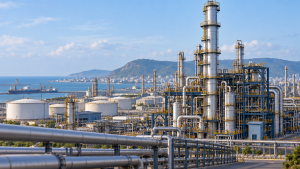
Hindustan Petroleum Corporation Limited (HPCL) commissioned its Residue Upgradation Facility (RUF) at the Visakh Refinery in Visakhapatnam, Andhra Pradesh, on January 5, 2026.
Capacity and technology
The facility has an annual capacity of 3.55 million tonnes (MMTPA) and uses LC-Max based residue hydrocracking technology. It is designed to convert approximately 93% of bottom oils into higher-value products. The RUF is India’s first residue hydrocracking unit and features the world’s first LC-Max unit.
Important Facts for Exams
- Bond cleavage: Hydrocracking combines catalytic cracking with added hydrogen to break carbon–carbon bonds; hydrotreatment is performed beforehand to protect the hydrocracking catalysts.
- Catalyst functions: Hydrocracking’s bifunctional catalysts rearrange and break hydrocarbon chains, while adding hydrogen to aromatics and olefins to produce naphthenes and alkanes.
- Residue contaminants: Vacuum residues concentrate asphaltenes and metals such as nickel and vanadium, which can foul or poison catalysts during conversion.
- Ebullated-bed operation: Ebullated-bed reactors suspend catalyst in upward-flowing feed and permit catalyst addition or withdrawal during operation, reducing replacement-related shutdowns.
Originally written on
January 5, 2026
and last modified on
November 19, 2026.
| Related | |
|---|---|