Great Indian Bustard Chicks Enter Rewilding Tunnel in Rajasthan
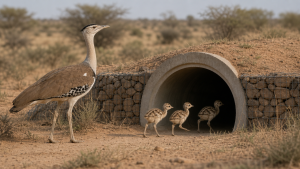
Three chicks of the Great Indian Bustard were released on 26 July 2026 into a specially designed rewilding tunnel at the Godawan Conservation Centre in Ramdevra, Jaisalmer, Rajasthan. The birds, identified as R9, R10 and R11, are one month old and include two males and one female.
Great Indian Bustard Conservation
The Great Indian Bustard is a critically endangered bird species found in arid and semi-arid grasslands of India. It is one of the heaviest flying birds in the world and is closely associated with the Thar Desert ecosystem. India’s Great Indian Bustard conservation programme includes captive breeding, habitat protection and planned release into natural landscapes. The current rewilding step marks a shift from captive breeding towards reintroduction into wild habitats.
Rewilding Tunnel and Facility Features
The rewilding facility at Ramdevra was built at a cost of ₹9.25 crore. It is designed to reduce human contact, simulate natural conditions and prepare captive-bred chicks for survival in the wild.
- The chicks will remain under continuous CCTV surveillance for about four months.
- Food will be supplied externally without direct human interaction.
- The tunnel is intended to help the birds develop foraging behaviour and desert adaptation.
- The facility supports safe rehabilitation before release into open habitat.
Desert National Park and Release Plan
After the rewilding phase, the chicks are expected to be released into the Desert National Park in Rajasthan. The park is a major habitat for the Great Indian Bustard and other desert fauna. Wildlife conservation in the Thar region includes protection of grasslands, control of habitat fragmentation and management of threats to ground-nesting birds.
Important Facts for Exams
- The Great Indian Bustard is listed as critically endangered on the IUCN Red List.
- Rajasthan is the main stronghold of the Great Indian Bustard in India.
- The species is protected under the Wildlife (Protection) Act, 1972.
- Desert National Park is located in the Jaisalmer and Barmer districts of Rajasthan.
Conservation Context
Captive breeding centres for the Great Indian Bustard operate in Rajasthan and other parts of India for species recovery. The use of a rewilding tunnel is a conservation method that prepares young birds for release by limiting dependence on humans.
| Related | |
|---|---|