Four Firms Receive Initial Approval for Rare Earth Magnet Scheme
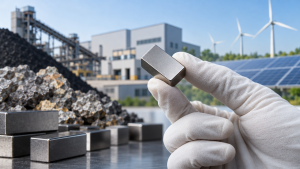
On 19 November 2026, the Ministry of Heavy Industries issued letters of intent (LoIs) to Coal India Ltd, ReNew Pvt Ltd, Prozeal Green Energy Ltd and Midwest Energy Ltd under the Rare Earth Permanent Magnet (REPM) Scheme. The LoIs are initial approvals; firms must provide performance guarantees and meet compliance requirements before receiving final letters of award.
Scheme targets and project details
Approved by the Union Cabinet on 26 November 2025, the scheme has an outlay of ₹7,280 crore. It envisages five beneficiaries and aims to establish 6,000 tonnes per year of integrated magnet-making capacity. The ministry has named four firms so far and has not specified whether it will select a fifth.
Coal India is the L2 bidder in a consortium with the Non-Ferrous Materials Technology Development Centre (NFTDC). Its proposed facility, to be set up through a special purpose vehicle, would produce 1,200 tonnes per year of sintered NdFeB magnets. The disclosed project schedule is seven years: two for pre-construction and five for operation.
Coal India sought no per-kilogram production incentive; reported bids by ReNew, Prozeal and Midwest ranged from ₹243 to ₹505. The announced LoI list did not include the IRP Infratech–BaRupOn consortium, which was also reported to have bid zero.
Important Facts for Exams
- Manufacturing classes: NdFeB magnets are classified as sintered or bonded according to the manufacturing process used.
- Grain-boundary diffusion: Dysprosium or terbium can improve NdFeB magnets’ resistance to demagnetisation at high temperatures, although these additions raise material costs.
- Magnetic alignment: During sintered NdFeB production, powder particles are aligned in a magnetic field before pressing, giving the finished magnet a preferred magnetisation direction.
- Lanthanide separation: Rare-earth elements have similar chemical properties, so separating them from mixed ores commonly requires repeated stages of solvent extraction.
| Related | |
|---|---|