Famous Indian Mathematicians and Their Contributions
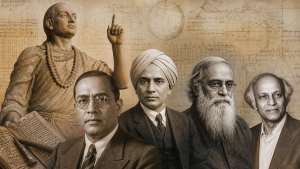
Indian mathematics developed across ancient, medieval and modern periods, shaping number systems, algebra, trigonometry, statistics and number theory. Its history includes foundational work on zero and place value, the Kerala School’s infinite series, and research that continues to influence advanced mathematics and India’s research ecosystem.
Foundations in Ancient India
Indian mathematical traditions advanced numerical notation and methods for calculation. The decimal place-value system and the use of zero were important foundations; later mathematicians formalised arithmetic rules and developed techniques for solving equations.
- Aryabhata (c. 476–550 CE): His work Aryabhatiya, composed in 499 CE, covered mathematics and astronomy. It described methods for extracting square and cube roots, gave an approximation of pi, and included a table of sines. In astronomy, Aryabhata described the apparent daily motion of the heavens in terms of Earth’s rotation; he did not propose a heliocentric model.
- Brahmagupta (c. 598–668 CE): In Brahmasphutasiddhanta, he set out rules for arithmetic involving zero and negative numbers, and discussed solutions to linear and quadratic equations. His formula for the area of a cyclic quadrilateral is known as Brahmagupta’s formula.
- Bhaskara II (c. 1114–1185 CE): Also known as Bhaskaracharya, he wrote Siddhanta Shiromani, which includes Lilavati on arithmetic and Bijaganita on algebra, as well as material on astronomy. His work on rates of change anticipated aspects of differential calculus, while his treatment of indeterminate equations included solutions to Pell-type equations.
Medieval Contributions: The Kerala School
The Kerala School of Mathematics and Astronomy flourished from the 14th to the 16th centuries. Its work on infinite series and trigonometric functions represents a major chapter in the history of mathematics, preceding comparable developments in Europe.
- Madhava of Sangamagrama (c. 1340–1425 CE): Regarded as the founder of the Kerala School, Madhava is associated with infinite series expansions for sine, cosine and arctangent. Series for pi and arctangent attributed to him are also known as the Madhava–Leibniz and Madhava–Gregory series. He developed methods for approximating irrational numbers.
- Nilakantha Somayaji (c. 1444–1544 CE): A leading successor to Madhava, Nilakantha developed the school’s work on trigonometric series and planetary models. His treatise Tantrasangraha presented and extended Kerala School results.
Srinivasa Ramanujan: A Modern Prodigy
Srinivasa Ramanujan (1887–1920) made influential contributions to number theory and mathematical analysis. Largely self-taught and without extensive formal mathematical training, he developed numerous results that attracted the attention of British mathematician G. H. Hardy.
- Cambridge collaboration: Hardy recognised Ramanujan’s talent and helped arrange his move to Cambridge in 1914. Their collaboration led to important work in mathematics.
- Research: Ramanujan studied partitions, highly composite numbers, infinite series, continued fractions and elliptic functions. His work also introduced mock theta functions, which remain a subject of mathematical research.
- Legacy: The material in Ramanujan’s “Lost Notebook” included many results that prompted further investigation and proofs by later mathematicians.
Other Eminent Indian Mathematicians
- P. C. Mahalanobis (1893–1972): A statistician, he developed the Mahalanobis distance, used in multivariate analysis, and established the Indian Statistical Institute (ISI) in Kolkata in 1931. As of October 2026, the ISI Bill, 2026, has been introduced in the Lok Sabha. It proposes changing the institute’s status from a registered society to a statutory body corporate.
- Harish-Chandra (1923–1983): An Indian-American mathematician, he made fundamental contributions to the representation theory of semisimple Lie groups and Lie algebras. His work also influenced harmonic analysis and number theory; “Harish-Chandra modules” are associated with this area of mathematics.
- Shakuntala Devi (1929–2013): Known as the “Human Computer”, she demonstrated exceptional mental calculation abilities, rapidly performing complex arithmetic without mechanical aids. Her mental arithmetic feats earned her a place in the Guinness Book of World Records.
Mathematical Heritage and Research
These contributions span both foundational mathematics and specialised modern fields. The Kerala School’s series, Ramanujan’s work in analysis and number theory, and Mahalanobis’s statistical methods illustrate the diversity of India’s mathematical heritage. Preserving this legacy also underlines the value of strong STEM education and a research ecosystem that supports original work.
Institutions such as ISI connect mathematical research with advanced training. The proposed change to ISI’s statutory status is therefore relevant to the governance of a major research institution, while the continuing recognition of Indian researchers highlights the importance of sustaining opportunities for high-level mathematical work.
Key Prelims Takeaways
- Aryabhata: Wrote Aryabhatiya in 499 CE; known for sine tables, an approximation of pi and astronomical work.
- Brahmagupta: Set out arithmetic rules for zero and negative numbers; his cyclic quadrilateral area formula bears his name.
- Bhaskara II: Wrote Siddhanta Shiromani, including Lilavati and Bijaganita; studied indeterminate equations.
- Kerala School: Madhava is regarded as its founder; the school developed infinite series for trigonometric functions.
- Ramanujan: Lived from 1887 to 1920; collaborated with G. H. Hardy and worked on partitions, infinite series and mock theta functions.
- Mahalanobis and ISI: Mahalanobis developed the Mahalanobis distance and established ISI in Kolkata in 1931.
Recent Context
Mahesh Kakde of IISc Bengaluru received the 2026 Ramanujan Prize for contributions to algebraic number theory. ICTP and IMU announced the award on September 30, 2026; IISc announced it on October 7. The prize, awarded annually since 2005, recognises researchers under 45 from developing countries.
| Related | |
|---|---|