Important Snake Species of India
India’s snakes occupy diverse habitats and play important ecological roles, including controlling rodent populations. Knowing the differences between medically significant venomous species and commonly encountered non-venomous snakes supports public safety, conservation and human-wildlife coexistence.
Classification of Snakes
Snakes are limbless reptiles in the order Squamata, which also includes lizards. India has approximately 300 snake species, of which about 60 are venomous. Venomous snakes have modified salivary glands that produce venom and specialised fangs to deliver it; non-venomous snakes lack this venom-delivery mechanism.
The “Big Four” Venomous Snakes
The Indian Cobra, Common Krait, Russell’s Viper and Saw-scaled Viper are known as the “Big Four” because they account for the majority of medically significant snakebites in India. All four are protected under Schedule II of the Wildlife Protection Act, 1972.
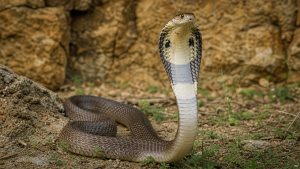
- Indian Cobra (Naja naja): Recognised by its hood, often marked with a spectacle-like pattern. It occurs across India in diverse habitats and is mainly nocturnal, though it may also be active by day. Its neurotoxic venom affects the nervous system and can cause paralysis.
- Common Krait (Bungarus caeruleus): A slender, glossy black or bluish-black snake with white bands. It is nocturnal and may enter rural dwellings. Its potent neurotoxic venom can cause respiratory failure; a bite may be painless, delaying recognition of symptoms.
- Russell’s Viper (Daboia russelii): A heavy-bodied snake with dark oval spots bordered by black rings. It is found in open grassland, farmland and rocky terrain. Its hemotoxic venom can cause tissue damage, blood-clotting disorders and kidney failure. It is known for its loud hiss.
- Saw-scaled Viper (Echis carinatus): The smallest of the Big Four, it has rough scales and is often sandy brown or grey. Found in dry, sandy and rocky areas, including parts of Rajasthan, Gujarat and Maharashtra, it produces a sizzling sound by rubbing its scales. Its hemotoxic venom can cause swelling, severe bleeding and renal failure.
Other Important Venomous Snakes
- King Cobra (Ophiophagus hannah): The world’s longest venomous snake, it can exceed 5 metres. It is primarily ophiophagous, meaning it preys on other snakes, and occurs in dense forests, especially in the Western Ghats and Northeast India. Its neurotoxic venom can be delivered in a large volume per bite. The species constructs nests for its eggs and is protected under Schedule II of the Wildlife Protection Act, 1972.
- Pit vipers: These snakes have heat-sensing pit organs between the eye and nostril. Examples include the Malabar Pit Viper (Trimeresurus malabaricus), Bamboo Pit Viper (Trimeresurus gramineus) and Hump-nosed Pit Viper (Hypnale hypnale). Many are arboreal and nocturnal. Their hemotoxic venom can cause local pain, swelling and tissue damage; bites by the Hump-nosed Pit Viper are medically significant in South India.
Important Non-Venomous Snakes
Many non-venomous snakes benefit agriculture by controlling rodent populations. Their appearance or defensive behaviour can lead to confusion with venomous species.
- Indian Rat Snake (Ptyas mucosa): A large, agile snake found in varied habitats, including urban areas. It is primarily diurnal and feeds on rodents, amphibians and birds. Its size and defensive posture can cause it to be mistaken for a cobra.
- Indian Rock Python (Python molurus): A large, heavy-bodied constrictor found in forests, grasslands and rocky areas, often near water. It kills prey, including mammals and birds, by constriction and is protected under Schedule I of the Wildlife Protection Act, 1972.
- Common Sand Boa (Eryx conicus): A stout-bodied, burrowing snake of sandy or loose soils. Its short, blunt tail can be mistaken for a second head. It is nocturnal, preys on rodents and is protected under Schedule IV of the Act.
- Wolf snakes: Many species belong to the genus Lycodon, part of the large family Colubridae. Wolf snakes are non-venomous; their sharp, long teeth help grip prey. Some have banding patterns that resemble those of kraits. They are typically nocturnal and secretive.
Conservation and Human-Wildlife Coexistence
Habitat loss, road accidents and deliberate killing driven by fear or misconceptions threaten snakes. The Wildlife Protection Act, 1972, provides legal protection to many species: Schedule I provides the highest level of protection, while Schedules II and IV also cover snakes.
- Conservation priorities: Protecting habitats, raising awareness and mitigating human-snake conflict support wildlife conservation and biodiversity protection.
- Coexistence: Accurate identification and understanding snakes’ ecological roles can help reduce unnecessary killing and support safer coexistence.
Key Prelims Takeaways
- India has approximately 300 snake species, including about 60 venomous species.
- The Big Four are the Indian Cobra, Common Krait, Russell’s Viper and Saw-scaled Viper.
- Cobra and krait venom is primarily neurotoxic; Russell’s Viper and Saw-scaled Viper venom is hemotoxic.
- The King Cobra is the world’s longest venomous snake and is ophiophagous.
- Pit vipers have heat-sensing pit organs between the eye and nostril.
- Wolf snakes are non-venomous; many belong to the genus Lycodon in the family Colubridae.
Recent Context
On October 6, 2026, a roughly 6-inch, two-headed wolf snake was rescued from Agaswani village in Gujarat’s Dahod district. The reported case of bicephaly, a developmental abnormality involving two heads, was described as the first recorded in Gujarat and the fifth reported in India.
| Related | |
|---|---|