Davanagere Finds Water Quality Problems in 59 Villages
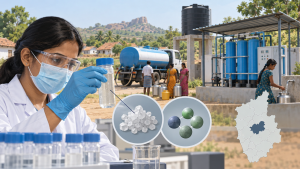
On 22 May 2026, tests by the Rural Drinking Water and Sanitation Department found that drinking water supplied to 59 villages in Davanagere district, Karnataka, contained chloride and fluoride above prescribed limits and was unfit for consumption. Davanagere Zilla Panchayat CEO Gitte Madhav Vithal Rao said 26,000 samples were tested at the Channagiri and Davanagere laboratories.
Water supply measures
Purification plants, private borewells and tankers were being used to provide potable water. Officials said problems had been resolved in 23 villages. Water was being supplied through private borewells to 20 villages and by tankers to four villages.
District purification units
Davanagere district had 790 water purification units using reverse osmosis (RO). Contractors managed 300 units and Gram Panchayats managed 400.
Important Facts for Exams
- RO membrane operation: Reverse osmosis membranes reject dissolved ions, including fluoride and chloride, but produce concentrated reject water that requires safe disposal and regular membrane maintenance.
- Effects of excess fluoride: Long-term ingestion of excess fluoride can cause dental fluorosis during tooth development and, at higher cumulative exposure, skeletal fluorosis; effects depend on dose and duration.
- Laboratory water tests: Fluoride in water is commonly quantified using an ion-selective electrode or SPADNS colourimetry, while chloride is often measured by argentometric titration.
- Panchayat responsibilities: India’s Eleventh Schedule lists drinking water among 29 potential Panchayat subjects under Article 243G, though state legislation determines which functions are actually devolved.
| Related | |
|---|---|