Page-3 of Computer & IT Awareness

National Informatics Centre
The National Informatics Centre (NIC) is a premier Indian government organisation under the Ministry of Electronics and Information Technology (MeitY) that provides technological support for e-governance initiatives across...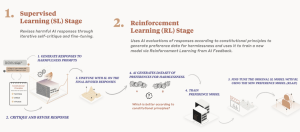
Constitutional AI
Constitutional AI is an approach to artificial intelligence alignment and safety that aims to guide AI systems’ behaviour using a predefined set of principles or “constitutional rules” rather...Graph Neural Network (GNN)
A Graph Neural Network (GNN) is a type of deep learning model designed to operate on graph-structured data. Unlike traditional neural networks, which typically process grid-like inputs such...Automated Facial Recognition
The National Crime Records Bureau (NCRB) has released a Request for Proposal for an Automated Facial Recognition System (AFRS) to be used by police officers across the country....
InfyTQ App Launched
IT giant, Infosys has launched the app InfyTQ app to offer learning and engagement experiences for engineering students. The online free platform InfyTQ is open to all engineering...Zettabyte
A zettabyte (ZB) is a unit of digital information storage that represents one sextillion (10²¹) bytes, or 1,000 exabytes. In binary terms, following the base-2 convention often used...Distributed Ledger Technology (DLT)
Distributed Ledger Technology (DLT) refers to a digital system for recording transactions or data across multiple computers in a decentralised manner. Unlike traditional centralised databases, distributed ledgers maintain...CERT-In
The Indian Computer Emergency Response Team (CERT-In) is the national nodal agency established by the Government of India to respond to and manage computer security incidents. Operating under...National Supercomputing Mission (NSM)
The National Supercomputing Mission (NSM) is a flagship initiative of the Government of India aimed at establishing a robust and self-reliant ecosystem for high-performance computing (HPC) within the...
Artificial intelligence
Artificial intelligence (AI) refers to the capability of computer systems to perform tasks traditionally associated with human intelligence, such as learning, reasoning, problem-solving, perception, and decision-making. As a...
Analytical engine
The Analytical Engine was a pioneering design for a general-purpose mechanical computer conceived by the English mathematician and inventor Charles Babbage during the nineteenth century. First outlined in...