CAZRI Standardises Dragon-Fruit Cultivation for Semi-Arid Rajasthan
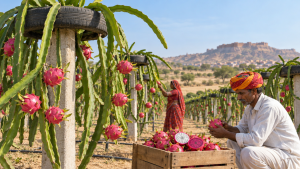
On 5 April 2026, the Central Arid Zone Research Institute (CAZRI), Jodhpur, announced a standardised approach to dragon-fruit cultivation in Rajasthan’s semi-arid regions. CAZRI Director S.P.S. Tanwar confirmed its suitability for the Thar region.
Cultivation trials and suitability
Farmers in Bilara, Jodhpur district, and several blocks of Pali district have started growing the fruit. CAZRI’s research found that it yields well in semi-arid areas but is less suitable for extremely dry districts such as Jaisalmer and Barmer. The plant requires at least 400 mm of rainfall and moisture in the air. Trials covered two varieties, both with pink outer skin: one has pink pulp and the other white pulp.
Plant support, yield and irrigation
Farmers are reportedly using old tyres instead of cement rings on support pillars to reduce cultivation costs. Typically, four plants grow on each pillar, producing an average of 25–30 kg of fruit. Plants begin bearing in their second year and can provide income for up to 10 years. CAZRI recommends drip irrigation, particularly in covered farms and for farmers with limited space.
Important Facts for Exams
- Arid-zone mandate: CAZRI is an autonomous ICAR institute under the Department of Agricultural Research and Education, devoted specifically to arid-zone research and development.
- Farmer outreach: CAZRI’s extension wing and Krishi Vigyan Kendras connect the institute with farmers and deliver regular training and demonstrations.
- Root-zone delivery: Drip irrigation delivers water directly to plant roots, helping minimise evaporation; its network uses pipes, tubing, valves and emitters.
| Related | |
|---|---|