Bengaluru Court Accepts Lokayukta B Report in MUDA Case
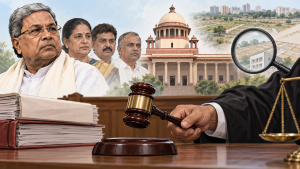
On January 28, 2026, the Special Court of Sessions for Criminal Cases against former and present MPs and MLAs in Bengaluru accepted the ‘B’ report, or closure report, filed by Karnataka Lokayukta police in the MUDA case. Judge Santosh Gajanan Bhat delivered the order.
Closure report and protest petition
The report concerned Chief Minister Siddaramaiah, his wife B.M. Parvathi, his brother-in-law Mallikarjuna Swamy and former landowner J. Devaraju, providing them relief in the case. The investigation concerned alleged irregularities and corruption in the allotment of sites by the Mysuru Urban Development Authority (MUDA). The court rejected complainant Snehamayi Krishna’s protest petition challenging the Lokayukta police investigation.
Investigation against other accused to continue
The court directed that investigations against the remaining accused in the broader MUDA case continue. The matter was listed for February 9 for the Lokayukta police to submit a final report on those investigations. The order did not end the entire case. The court said the Enforcement Directorate could intervene only to a “limited extent” as an aggrieved party.
Important Facts for Exams
- Closure-report hearing right: Before accepting a police closure report, a court must give the informant notice and an opportunity to be heard, under the Supreme Court’s Bhagwant Singh rule.
- Court’s closure-report options: On receiving a closure report, a criminal court may accept it, take cognisance despite it, or direct further investigation; these are distinct procedural outcomes.
- Lokayukta’s dual functions: Karnataka’s Lokayukta combines an ombudsman inquiry function with a police wing that investigates corruption offences; these are distinct institutional tracks.
- PMLA predicate-offence link: Under the PMLA, proceeds of crime must be linked to a scheduled offence; money-laundering proceedings are distinct from investigation of that predicate offence.
| Related | |
|---|---|