Amazon Plans $7 Billion Renewable Energy Investment in India by 2030
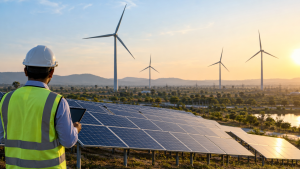
On 17 November 2026, Amazon announced plans to invest an additional 7 billion in renewable-energy projects in India by 2030. This is separate from the 4 billion already contracted for projects in the country.
Four new wind and solar projects
Amazon announced four utility-scale projects with a combined capacity of 934 megawatts (MW). They comprise a 234 MW wind farm in Bijapur, Karnataka—its largest contracted wind project in Asia to date; a 200 MW combined solar-and-wind project in Tumkur, Karnataka; a 300 MW solar project in Mandsaur, Madhya Pradesh; and a 200 MW solar project in Dinkar, Rajasthan. Secured through Power Purchase Agreements (PPAs), these projects form part of the existing $4 billion contracted portfolio. Once operational, Amazon’s contracted projects in India are expected to exceed 2 gigawatts (GW) of capacity, with generation equivalent to the annual electricity needs of more than 3.5 million households.
Company targets and portfolio
The investment contributes to Amazon’s global target of cutting the carbon intensity of electricity powering its operations by 65% by 2030, against a 2019 baseline. The target forms part of The Climate Pledge, which aims for net-zero carbon across Amazon’s operations by 2040. Its India portfolio includes 14 utility-scale wind and solar projects and 43 on-site solar installations. Union Minister for New and Renewable Energy Pralhad Joshi welcomed the investment, citing its role in clean-energy ambitions, energy security and sustainable economic growth.
Important Facts for Exams
- Contract term and price: A power purchase agreement is a long-term contract, potentially lasting 5–20 years, under which the buyer purchases electricity at a pre-negotiated price.
- Renewable project finance: Power purchase agreements play a key financing role for independently owned electricity generators, particularly renewable producers such as wind and solar farms.
- Seller’s financing vehicle: Under a power purchase agreement, the seller is often organised as a special-purpose entity to facilitate non-recourse project financing.
- Pay-as-produced structure: In a pay-as-produced power purchase agreement, the buyer purchases electricity as generated, accepting generation risk from weather-related fluctuations.
| Related | |
|---|---|