15th or 16th Century Land-Grant Inscription Reported in Mandya
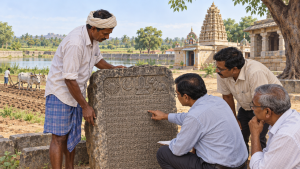
On 14 June 2026, a 23-line Kannada inscription believed to date to the 15th or 16th century was reported near the Sri Veerabhadreshwara and Kollapuradamma temples in Dadaga village, Nagamangala taluk, Mandya district, Karnataka.
Discovery and identification
Farmer Shankarappa found the carved stone while ploughing his field and brought it to the village temple. Writer and researcher Mohammed Kaleem Ulla visited Dadaga and identified it as an ancient Kannada record. Its carvings depict the Sun, Moon, Shiva Linga and Nandi. For detailed study, Kaleem Ulla consulted scholars M.N. Prabhakar and Dr. Nagaraja Rao.
Details of the land grant
Experts interpreted the inscription as a land grant dated to Virodhi Samvatsara, Jyestha Shukla Pratipada—the first day of the bright half of Jyestha—which fell on a Monday. It records that Gopaladeva granted land near a tank at Somagahalli to Basava devotees and their descendants. The inscription specifies the land boundaries and names 13 beneficiaries.
Important Facts for Exams
- Inscriptional media: Kannada epigraphs were generally recorded on stone as shilashasana or on copper plates as tamarashasana, two distinct inscriptional media.
- Language periods: Kannada inscriptions have helped classify linguistic eras as Proto Kannada, Pre Old Kannada, Old Kannada, Middle Kannada and New Kannada.
- Land-boundary wording: The 444 CE Tumbula inscription combines Sanskrit and Kannada, using Kannada words to describe land boundaries.
| Related | |
|---|---|