Bring out the relationship between the shrinking Himalayan glaciers and the symptoms of climate change in the Indian sub-continent. (UPSC 2014)
Shrinking Himalayan glaciers are both a result and a warning sign of climate change in the Indian sub-continent. They reflect rising temperatures at high altitudes, while also triggering wider environmental and socio-economic stress across the plains.
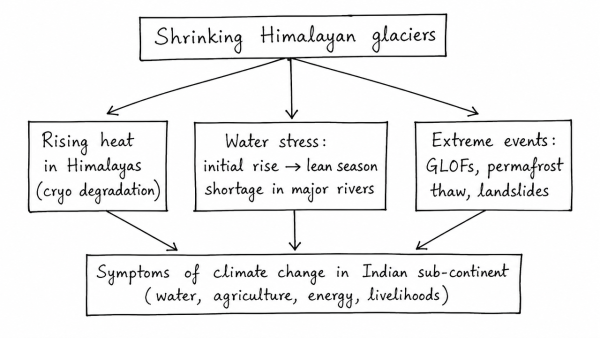
- Rising heat in the Himalayas: Faster warming in the Hindu Kush Himalaya has reduced glacier area and ice reserves, showing clear cryosphere degradation.
- Water stress: Faster melting first raises river flow, then weakens lean-season supply in the Indus, Ganga and Brahmaputra basins, affecting drinking water, irrigation and hydropower.
- Extreme events: Meltwater lakes, permafrost thaw and slope instability increase glacial lake outburst floods, landslides and flash floods, as seen in Chamoli and Sikkim.
- Monsoon and snowfall changes: Glacier retreat disturbs local heat balance, adds to erratic rainfall and reduces snow cover, both symptoms of climate variability.
Thus, shrinking glaciers act as a climate indicator and a driver of risk. Protecting them needs emission cuts, glacier monitoring, early warning systems and climate-resilient water management.
Originally written on
August 29, 2026
and last modified on
August 29, 2026.