United Nations Security Council Powers under Chapter VII
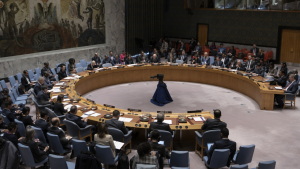
The United Nations Security Council (UNSC) has primary responsibility for maintaining international peace and security. Chapter VII of the UN Charter gives it authority to determine threats to peace and adopt enforcement measures, including sanctions and, in specified circumstances, military action.
The Charter and the Security Council’s Role
Signed in 1945, the UN Charter sets out the purposes and principles of the United Nations. Article 1 identifies maintaining international peace and security as a central purpose. Under Article 24(1), the Security Council bears primary responsibility for this function. The Council has 15 members: five permanent members and ten non-permanent members. Chapters VI and VII provide distinct routes for responding to disputes and threats. Chapter VI focuses on peaceful settlement; Chapter VII enables enforcement action. These powers place the Council at the centre of the UN collective security system, while also making its effectiveness dependent on agreement among its members.
Chapter VI and Chapter VII
Chapter VI, Articles 33–38, concerns the pacific settlement of disputes. The Council may investigate disputes, recommend procedures or methods of adjustment, and propose terms of settlement. The approaches include negotiation, mediation, conciliation and arbitration. Chapter VI action is generally recommendatory and seeks a peaceful resolution rather than coercive enforcement. Chapter VII, Articles 39–51, concerns action in response to threats to the peace, breaches of the peace and acts of aggression. It permits the Council to decide on enforcement measures, which UN members are required to accept and carry out under Article 25. Such measures do not generally depend on the consent of the parties to a conflict. The distinction is important: Chapter VI provides a framework for peaceful settlement, whereas Chapter VII authorises coercive measures to maintain or restore international peace and security. The Council can choose measures according to the situation; the Charter does not require it to exhaust every Chapter VI option first.
Article 39: The Gateway to Enforcement
Article 39 is the gateway to Chapter VII enforcement. The Council determines whether there is a threat to the peace, breach of the peace or act of aggression. Following that determination, it may make recommendations or decide what measures are necessary to maintain or restore international peace and security. A determination under Article 39 is the basis for measures under Articles 41 and 42. The Council has interpreted “threat to the peace” broadly. Its use has extended beyond conflicts between states to include internal conflicts with regional implications, international terrorism and the proliferation of weapons of mass destruction. This flexibility allows the Council to address changing forms of risk, but also gives its members considerable influence over which situations receive collective action.
Articles 41 and 42: Enforcement Measures
Article 41 authorises measures that do not involve the use of armed force. The Council may decide that UN members should apply such measures to give effect to its decisions. They can include:
- Complete or partial interruption of economic relations.
- Interruption of rail, sea, air, postal, telegraphic, radio and other means of communication.
- Severance of diplomatic relations.
- Sanctions such as arms embargoes, travel bans and financial restrictions against states, groups or individuals.
The Council has also used Article 41 to establish international criminal tribunals and civil administrations of territories. The core provisions of Articles 41 and 42 remain unchanged by recent Charter amendments, which have focused on the membership and voting of the Security Council and the Economic and Social Council.
Military action under Article 42
If the Council considers Article 41 measures inadequate, or finds that they have proved inadequate, Article 42 permits action by air, sea or land forces. This may include demonstrations, blockade and other operations necessary to maintain or restore international peace and security. The Charter does not require the Council to impose sanctions before authorising military action. The UN has no standing army. Military action therefore relies on forces provided by UN members, multinational forces or regional organisations authorised by the Council. Resolutions authorising “all necessary measures” commonly indicate permission to use force. Such authority raises questions about the limits, accountability and legitimacy of force in collective security.
Peacekeeping, Veto and Institutional Reform
Some modern peacekeeping operations have Chapter VII mandates, particularly in volatile post-conflict settings. A mandate may permit force for self-defence or to protect civilians from imminent threats of physical violence. However, a Chapter VII mandate does not by itself make an operation a peace-enforcement mission: its character depends on the resolution, the powers granted and the role of consent. The Council’s ability to act is also shaped by the veto. Under Article 27(3), substantive decisions require the prescribed support, including the concurring votes of the permanent members: China, France, Russia, the United Kingdom and the United States. A negative vote by any one of them can block a resolution. This can produce deadlock, including when a crisis affects the interests of a permanent member or its allies. The veto raises a central issue of UN institutional reform: how to improve the Council’s representativeness and capacity to respond while preserving the Charter’s decision-making arrangements. The balance between collective action and the use of force remains a key concern for international peace and security.
Key Prelims Takeaways
- Chapter VII covers threats to the peace, breaches of the peace and acts of aggression.
- Article 39 authorises the Council to make the relevant determination.
- Article 41 provides for non-military measures, including economic and communications restrictions.
- Article 42 permits air, sea or land operations if Article 41 measures are inadequate.
- Article 25 requires UN members to accept and carry out Security Council decisions.
- A Chapter VII peacekeeping mandate does not automatically make a mission peace enforcement.
Recent Context
The India–Malaysia joint military exercise HARIMAU SHAKTI–VI commenced in Ipoh, Malaysia, on 19 November 2026. The exercise rehearses sub-conventional operations under a Chapter VII UN mandate, with emphasis on coordinated counter-terrorism responses.
| Related | |
|---|---|