Grid Stabilisation and Ancillary Services in India
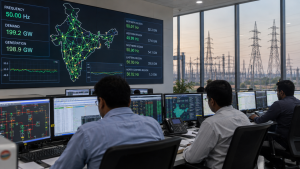
Grid stabilisation keeps electricity supply and demand balanced while maintaining frequency and voltage within permissible limits. Ancillary services provide the operational support needed to manage disturbances, integrate variable generation and maintain reliable power supply across the interconnected grid.
Need for Grid Stabilisation
India’s grid must continuously balance electricity generation with demand. Maintaining the system frequency at 50 Hz and keeping voltage within acceptable limits are essential for reliable operation and the safe functioning of electrical equipment. Frequency or voltage deviations can affect equipment and, if not managed, contribute to wider system disturbances. Solar and wind generation vary with weather and time of day. Their integration therefore increases the need for resources that can respond to changing output and demand. Grid operators must make real-time adjustments, using available generation, reserves and other support services to maintain the balance.
- Frequency stability: Keeps the system close to the nominal 50 Hz frequency by matching supply and demand.
- Voltage stability: Maintains acceptable voltage profiles across the grid, including through reactive power support.
Ancillary Services and Their Functions
Ancillary services are functions provided by designated resources to support the reliable operation of the interconnected transmission system. They help maintain security and quality of supply, and enable operators to respond to imbalances, transmission constraints and outages.
- Primary frequency response: An automatic, near-instantaneous change in generation or load following a frequency deviation. It arrests a frequency fall or rise.
- Secondary frequency response: Restores frequency to 50 Hz and tie-line power flows to scheduled values within minutes, primarily through Automatic Generation Control (AGC).
- Tertiary response: Deploys reserves, manually or automatically, over a longer period, such as 10–15 minutes. It also helps restore secondary reserves.
- Reactive power and voltage support: Helps maintain voltage within acceptable limits. Reactive power does not transmit useful energy, but is necessary for voltage support.
- Black start: Enables a generating unit to start without an external power supply and energise other units or the grid. It is important in restoring supply after a widespread blackout.
- Congestion management: Relieves transmission bottlenecks so that power flows remain within thermal limits.
- Reserve capacity: Keeps additional generation online or ready for deployment to meet unexpected demand increases or the sudden loss of generation.
Regulatory Framework and Institutions
The Electricity Act, 2003 provides the legal foundation for the power sector, including provisions relevant to grid operation and reliability. The Central Electricity Regulatory Commission (CERC) sets the regulatory framework for ancillary services through regulations that define the services and provide for their procurement and scheduling. The CERC (Ancillary Services) Regulations, 2021, and subsequent amendments form the framework for these services. Their implementation depends on coordination among national, regional and state-level system operators, as grid operations and imbalances occur across interconnected networks.
- Grid Controller of India Ltd.: Formerly known as POSOCO, it operates the National Load Despatch Centre (NLDC) and Regional Load Despatch Centres (RLDCs). It implements CERC regulations for ancillary services.
- NLDC: Oversees national grid operation, facilitates inter-regional power transfers and manages ancillary services at the national level.
- RLDCs: Manage grid operation within their respective regions, including regional ancillary services.
- State Load Despatch Centres (SLDCs): Manage grid operations within their respective states.
Resources and Grid Support Technologies
Different technologies provide distinct forms of grid support. The services available from a resource depend on its operating characteristics: some respond quickly to frequency changes, while others support voltage, provide reserves or help restore a de-energised grid.
- Thermal power plants: Coal- and gas-fired plants can provide inertia, frequency response and reactive power support while operating. They can also offer ramping capability for flexible generation.
- Hydropower plants: Units with fast-acting governors can respond to frequency changes. Hydropower plants can also provide black-start capability.
- Pumped hydro storage: These projects can switch between pumping, which consumes electricity, and generation, which supplies it. They can provide rotational inertia, reactive power support and rapid primary and secondary frequency response.
- Energy balancing by storage: Pumped hydro can absorb surplus power and release it when required, helping manage variability in generation and demand.
- Battery Energy Storage Systems (BESS): Batteries can provide fast frequency response, voltage support and ramp-rate control. Their modularity and flexibility are useful for different grid-support needs.
- Synchronous condensers: These rotating machines do not generate active power but provide reactive power and inertia, supporting voltage stability.
- Demand-side management and FACTS: Demand-side management adjusts consumer demand in response to grid signals or pricing. Flexible AC Transmission Systems devices, including STATCOM and SVC, use power electronics to support voltage, transmission capacity and power-flow control.
Key Prelims Takeaways
- Grid stabilisation maintains frequency at 50 Hz and keeps voltage within permissible limits.
- Ancillary services support reliable operation and quality of supply in the interconnected grid.
- Primary response is automatic and near-instantaneous; secondary response restores frequency and scheduled tie-line flows; tertiary response deploys reserves over a longer period.
- The Electricity Act, 2003 and CERC’s 2021 Ancillary Services Regulations form key parts of the regulatory framework.
- Grid Controller of India Ltd. operates the NLDC and RLDCs; SLDCs manage operations within states.
- Black start means starting a generating unit without external power and using it to help restore the grid.
Recent Context
Madhya Pradesh Chief Minister Mohan Yadav inaugurated one operating unit of Greenko Group’s Gandhi Sagar Pumped Hydro Storage Project on November 18, 2026. The project is planned for 1,920 MW across nine units; full commercial operations are targeted for June 2027. Its storage and grid-support capabilities highlight the role of pumped hydro in grid resilience.
| Related | |
|---|---|