Rare Earth Processing and Separation Technologies
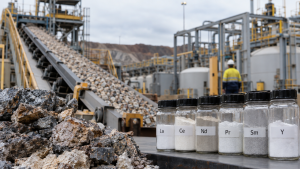
Rare earth elements are essential inputs for magnets, catalysts, displays and other technologies. Turning rare earth-bearing ores into individual, high-purity elements is challenging because the elements have closely similar chemical properties and are often dispersed in deposits.
Understanding Rare Earth Elements
Rare earth elements (REEs) comprise the 15 lanthanides, scandium and yttrium. Despite the name, they are not uniformly scarce in the Earth’s crust: cerium, for example, is more abundant than copper. The key challenge is finding economically workable concentrations and separating the elements efficiently.
- Light rare earth elements (LREEs): Lanthanum through samarium, with atomic numbers 57–62. They are generally more abundant and form a large share of many deposits.
- Heavy rare earth elements (HREEs): Europium through lutetium, with atomic numbers 63–71, together with yttrium. Yttrium is grouped with HREEs because of its similar chemical behaviour and ionic radius.
- Applications: REEs are used in permanent magnets for electric vehicles and wind turbines, oil-refining catalysts, display phosphors and defence systems.
From Ore to Rare Earth Concentrate
Processing begins with mining and proceeds through physical concentration and chemical extraction. The sequence varies with the ore and the minerals hosting the REEs.
- Mining: Rare earth-bearing rock, sand or clay is extracted, commonly by open-pit or underground methods.
- Comminution: Crushing and grinding reduce the ore to a size suitable for separating valuable minerals from unwanted material.
- Beneficiation: Flotation separates minerals according to their surface properties and is used for minerals such as bastnäsite. Magnetic separation exploits differences in magnetic behaviour to remove some minerals from non-magnetic gangue.
- Leaching and cracking: Chemical treatment dissolves REEs from the concentrated minerals. Depending on the mineral, this can involve roasting followed by acid treatment with sulfuric, hydrochloric or nitric acid, or alkaline cracking.
For ion-adsorption clay deposits, in-situ leaching with ammonium sulfate solutions can recover REEs into a mixed solution. These steps produce a mixed rare earth solution or an intermediate product, not usually individual high-purity elements. The resulting mixture must undergo further separation and purification.
Separation and Purification Technologies
Separating individual REEs is a critical processing stage. Their similar chemical properties, associated with lanthanide contraction, make selective separation difficult and mean that industrial processes often require many repeated stages.
- Solvent extraction: The predominant industrial method. REE ions are distributed between an aqueous, usually acidic, phase and an immiscible organic phase, often kerosene containing phosphorus-based extractants. Repeated stages selectively transfer elements between phases until they are separated to the required purity. The method is effective but requires substantial chemical inventories and generates acidic wastewater.
- Ion exchange: A solution passes through columns containing resins that selectively bind REE ions. The bound elements are then released, or eluted, using suitable solutions. Ion exchange can provide precise separation, particularly for heavy REEs, and can yield high-purity materials.
- Precipitation: Adjusting pH or adding reagents causes selected REEs to form insoluble compounds. Oxalates and carbonates are commonly precipitated and then may be calcined to produce rare earth oxides.
Rare Earth Permanent Magnet Production
Neodymium-iron-boron (NdFeB) magnets are important because of their high magnetic strength. Sintered NdFeB magnets are produced through powder metallurgy, in which powder preparation, alignment and heat treatment determine the finished magnet’s properties.
- Alloy preparation: High-purity neodymium, iron and boron, sometimes with dysprosium or terbium, are melted in a vacuum induction furnace. Strip casting rapidly cools the alloy into thin flakes.
- Powder production: The flakes are broken down into fine particles, typically through hydrogen decrepitation followed by jet milling.
- Alignment and pressing: Before pressing, powder particles are aligned in a magnetic field. This gives the final magnet a preferred magnetisation direction, or anisotropy. The powder is then compacted into a “green” compact.
- Sintering and heat treatment: Compacts are sintered at high temperatures, stated as 1,000–1,400°C, to increase density and fuse the particles. Subsequent heat treatment optimises magnetic properties.
- Sintered and bonded types: Sintered magnets are made through powder metallurgy and generally achieve higher density and magnetic performance. Bonded magnets use plastic resins and have lower magnetic properties.
- Grain-boundary diffusion: Dysprosium or terbium can be applied to sintered magnet surfaces and diffused at lower temperatures. This can improve resistance to demagnetisation at high temperatures, but increases material costs.
Processing Challenges and Priorities
Rare earth processing requires substantial chemical inputs and can generate acidic wastewater. Sustainable mining and effective pollution regulation are therefore important alongside the development of processing capacity. Building research capacity can support improved separation techniques and more efficient use of materials, including heavy REEs used to enhance magnet performance.
Key Prelims Takeaways
- REEs comprise 15 lanthanides, scandium and yttrium.
- LREEs run from lanthanum to samarium; HREEs run from europium to lutetium and include yttrium.
- Economic concentration and separation, rather than uniform geological scarcity, are major challenges.
- Processing includes mining, beneficiation, chemical extraction and separation.
- Solvent extraction is the main industrial method; ion exchange and precipitation are also used.
- NdFeB magnets may be sintered or bonded; magnetic alignment occurs before pressing in sintered production.
Recent Context
On November 19, 2026, the Ministry of Heavy Industries issued LoIs to Coal India Ltd, ReNew Pvt Ltd, Prozeal Green Energy Ltd and Midwest Energy Ltd under the ₹7,280 crore REPM Scheme. LoIs are initial approvals; Coal India’s proposed facility would produce 1,200 tonnes of sintered NdFeB magnets annually.
| Related | |
|---|---|