Types of Submarines and Their Strategic Roles
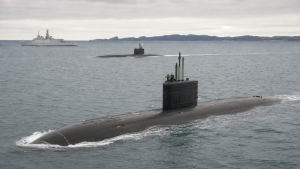
Submarines combine stealth, endurance and firepower, making them important to maritime security and national defence. Their classification reflects both propulsion and mission: nuclear or conventional power determines how they operate, while their weapons and tasks distinguish strategic deterrent submarines from attack and guided-missile boats.
Classification by Propulsion
Propulsion affects a submarine’s endurance, speed, operating area and acoustic signature. Nuclear-powered vessels can sustain high speeds for long periods, while conventional submarines are often suited to regional operations.
- Nuclear-powered submarines: A reactor generates heat to produce steam, which drives turbines and supplies electricity. These submarines do not need frequent fuel replenishment, giving them long range and endurance. Patrol length is still constrained by food, maintenance and crew requirements; “indefinite” submerged operation does not mean unlimited deployment.
- Conventional diesel-electric submarines (SSK): Diesel engines drive generators that charge batteries. Electric motors propel the submarine underwater, but the vessel must periodically surface or snorkel to run its engines, recharge batteries and expel exhaust.
- Air-Independent Propulsion (AIP): Some conventional submarines use systems such as fuel cells, Stirling engines or closed-cycle diesel engines to extend submerged operation without snorkeling. AIP improves endurance but does not give an SSK the range or sustained high-speed capability of a nuclear submarine.
- Operational profile: Conventional submarines are generally smaller and can be quieter than nuclear-powered boats at slower speeds. They are well suited to coastal defence and regional missions, while nuclear submarines’ endurance supports operations over greater distances.
Classification by Role and Armament
Letter designations identify a submarine’s principal function and, in some cases, its propulsion. SSBNs and SSGNs are generally nuclear-powered; SSNs are nuclear-powered attack submarines, while SSKs are conventionally powered attack submarines.
- Ballistic missile submarines (SSBN): These carry submarine-launched ballistic missiles (SLBMs) and form a sea-based element of a nuclear deterrent. Concealment and lengthy patrols help preserve the ability to retaliate after an adversary’s first strike. The Russian Borei class and the US Ohio class are examples.
- Attack submarines (SSN/SSK): Their missions include hunting enemy submarines and surface warships, reconnaissance and protecting friendly naval forces. Torpedoes are a principal weapon; some also carry anti-ship cruise missiles. They support anti-submarine warfare (ASW) and anti-surface warfare (ASuW).
- Guided missile submarines (SSGN): These are configured to carry substantial numbers of guided missiles, including land-attack cruise missiles and anti-ship missiles. They can strike land targets from a concealed position; some, including US Ohio-class SSGNs, were converted from SSBNs. Certain boats can also support special operations forces.
- Bulava and the Borei class: The Russian Bulava (RSM-56) is a nuclear-capable SLBM with a stated range exceeding 8,000 kilometres. It can carry multiple warheads; some reports estimate six to ten. Its first two stages use solid propellant and its third stage uses liquid fuel. The missile can be launched from an inclined position while the submarine is moving.
Key Technologies and Design Features
Submarine design seeks to reduce the likelihood of detection while improving sensing, navigation and combat performance. Acoustic concealment is particularly important because sonar can reveal a vessel’s position.
- Noise reduction: Pump-jet propulsion uses an enclosed impeller rather than a traditional exposed propeller and can reduce cavitation noise. The Borei class introduced pump-jet propulsion on a Russian nuclear submarine.
- Anechoic tiles: Rubber or polymer tiles on the hull absorb some incoming active-sonar energy and reduce the submarine’s acoustic signature. They complement, rather than replace, quiet propulsion and operating practices.
- Sonar systems: Passive sonar listens for sounds, while active sonar emits sound waves and detects their echoes. Hull-mounted, flank and towed arrays provide different ways to detect and track objects.
- Hull and control surfaces: Compact hull designs can help reduce broadband noise. Project 955A (Borei-A) boats have all-moving rudders and vertical hydroplane endplates, design features intended to improve manoeuvrability.
- Automation and combat systems: Integrated navigation, data-processing and weapon-control systems support operations and can reduce crew requirements. Their effectiveness depends on combining information from sensors with timely command decisions.
Strategic Roles and Defence Significance
Submarines contribute to deterrence and day-to-day maritime operations. Their covert presence can complicate an adversary’s planning, but their strategic value depends on readiness, trained crews, maintenance and integration with wider naval forces.
- Strategic deterrence: SSBNs can provide a concealed second-strike capability: the ability to retaliate with nuclear weapons after an initial attack on a country’s nuclear forces. Their survival and secure communications are central to this role.
- Sea denial and control: Attack submarines can threaten opposing ships and submarines, restrict access to particular waters and help protect sea lanes. These missions support maritime security and wider naval operations.
- Intelligence, surveillance and reconnaissance: Submarines can covertly monitor naval movements and activity near hostile coastlines. Their ability to operate unseen makes them useful for gathering information without maintaining a visible presence.
- Power projection and special operations: SSGNs can launch cruise-missile strikes against land targets from a concealed position. Some submarines can also insert or extract special operations teams for covert missions.
Key Prelims Takeaways
- Propulsion categories include nuclear-powered submarines and conventional diesel-electric submarines (SSKs).
- SSBNs carry SLBMs for strategic nuclear deterrence; SSNs and SSKs are attack submarines.
- SSGNs carry guided missiles, including cruise missiles for land attack; some were converted from SSBNs.
- AIP extends a conventional submarine’s underwater endurance without snorkeling, but does not remove its operational limits.
- Pump-jet propulsion and anechoic tiles help reduce acoustic detection; sonar may be active or passive.
- The Borei class uses pump-jet propulsion. The Bulava is a nuclear-capable SLBM with a stated range exceeding 8,000 kilometres.
Recent Context
On 28 October 2026, Russia reported a Bulava test launch from the submerged Borei-A-class Generalissimo Suvorov in the Sea of Okhotsk; warheads reportedly reached the Chizha test range. Russia’s Ministry of Defence called it routine combat training, but the claims have not been independently verified by international media.
| Related | |
|---|---|