Nuclear Triad and Second-Strike Capability
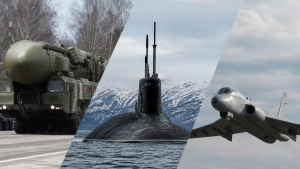
A nuclear triad combines land-, sea- and air-based systems for delivering nuclear weapons. By diversifying launch platforms, a state seeks to preserve forces after an attack and maintain the ability to retaliate—a capability central to nuclear deterrence and strategic stability.
The Nuclear Triad: Three Delivery Legs
A triad is a system of land-based intercontinental ballistic missiles (ICBMs), submarine-launched ballistic missiles (SLBMs) and nuclear-capable aircraft. Each leg has different strengths and vulnerabilities. Their combination makes it harder for an adversary to destroy a country’s entire nuclear force in a surprise first strike.
- Land-based missiles: ICBMs may be housed in hardened silos or deployed on mobile transporter erector launchers (TELs). Silos can support rapid response but are fixed locations; mobile launchers can relocate and conceal their position.
- Sea-based systems: Nuclear-powered ballistic missile submarines (SSBNs) carry SLBMs. Their ability to operate covertly makes them difficult to detect and destroy, and therefore a particularly survivable part of a triad.
- Air-based systems: Strategic bombers can carry nuclear bombs or air-launched cruise missiles (ALCMs). Aircraft can be recalled or redirected, offering flexibility, and their deployment can visibly signal resolve.
The three legs provide redundancy: the loss or vulnerability of one delivery system need not eliminate the capacity to retaliate. A triad is not simply a count of platforms; its deterrent value depends on their survivability, readiness and integration with command and control.
Second-Strike Capability and Deterrence
Second-strike capability is the ability to absorb a nuclear first strike and retain sufficient nuclear forces to launch a retaliatory attack. The prospect of retaliation is intended to deter an adversary from initiating nuclear use: even a successful attack on some forces cannot guarantee freedom from a response. This logic is associated with mutual assured destruction (MAD), the idea that a full-scale nuclear exchange between opposing sides could lead to the annihilation of both. It does not mean that retaliation is automatic or that every nuclear state has identical capabilities. A credible second strike requires forces and decision-making arrangements able to survive and function after an attack.
- Survivability: Enough delivery systems and weapons must remain usable after an initial strike.
- Concealment: Hard-to-locate forces, especially SSBNs, reduce the chance that an adversary can eliminate the entire arsenal.
- Command and control: The chain of command must remain sufficiently intact to authorise and communicate a retaliatory response.
- Retaliatory capacity: Surviving weapons and delivery systems must be sufficient to make the threat of substantial damage credible.
The triad supports this capability by spreading forces across different platforms and operating environments. It does not guarantee that every component will survive; rather, it complicates efforts to conduct a disarming first strike.
Strategic Stability and Security Considerations
Nuclear deterrence depends on an adversary believing that a first strike cannot prevent retaliation. A survivable second strike can therefore reduce incentives to attack nuclear forces pre-emptively. At the same time, the existence of nuclear forces and the possibility of miscalculation remain central concerns for national security and strategic stability.
- Redundancy: Multiple delivery modes reduce dependence on any single platform.
- Survivability versus vulnerability: Fixed silos may be exposed locations, while mobile missiles and submarines offer greater concealment.
- Visible signalling: Bomber operations can demonstrate resolve, but differ from the covert posture of submarines.
A triad’s effectiveness thus depends not only on the number of weapons, but also on whether forces can survive, communicate and respond. Maintaining these systems also entails substantial technological and financial investment.
Global Nuclear Triad Capabilities
The United States, Russia and China possess or are developing the three delivery legs. The level and configuration of each country’s forces differ.
- United States: Its systems include Minuteman III ICBMs, Ohio-class SSBNs carrying Trident II SLBMs, and B-52 Stratofortress and B-2 Spirit strategic bombers.
- Russia: Its triad includes ICBMs such as Yars, Borei-class SSBNs carrying Bulava SLBMs, and Tu-95 Bear and Tu-160 Blackjack strategic bombers.
- China: Its expanding triad includes DF-41 ICBMs, Type 094 Jin-class SSBNs carrying JL-2 SLBMs, and H-6 strategic bombers.
- United Kingdom and France: Their strategic nuclear forces rely primarily on sea-based deterrence.
India’s Doctrine and Triad Components
India’s nuclear doctrine is based on No First Use (NFU) and Credible Minimum Deterrence (CMD). NFU means India will not be the first to use nuclear weapons. CMD refers to maintaining a sufficient, survivable force to inflict unacceptable damage in retaliation. A credible triad supports this posture by diversifying potential retaliatory platforms.
- Land: The Agni missile series, including Agni-V and Agni-P, forms part of India’s land-based deterrent, with missiles offering different ranges and capabilities.
- Sea: Arihant-class SSBNs are designed to carry K-series SLBMs. The sea-based leg is intended to strengthen the survivability of a retaliatory force.
- Air: Aircraft identified as part of India’s air-based nuclear delivery capability include the Rafale, Mirage 2000 and Sukhoi Su-30MKI.
Key Prelims Takeaways
- A nuclear triad comprises land-based missiles, sea-based missiles and air-delivered nuclear weapons.
- Second-strike capability means retaining the ability to retaliate after a nuclear first strike.
- SSBNs are considered a highly survivable triad leg because they are difficult to detect.
- MAD links the threat of retaliation with deterrence against a full-scale nuclear attack.
- India’s doctrine includes NFU and CMD; its triad components include Agni missiles and Arihant-class SSBNs.
- ICBMs are land-based, while SLBMs are launched from submarines; ALCMs are carried by aircraft.
Recent Context
On October 28, 2026, Russia’s Ministry of Defence reported a successful Bulava SLBM test from the submerged Borei-A-class submarine Generalissimo Suvorov in the Sea of Okhotsk. It said the warheads reached the Chizha test range and described the launch as routine training demonstrating second-strike capability; the claims were not independently verified.
| Related | |
|---|---|