Strategic Geography of the Indo-Pacific: Island Chains and Key Chokepoints
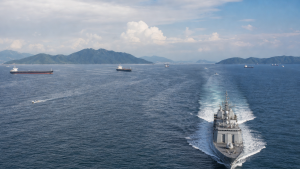
The Indo-Pacific links the Indian and Pacific Oceans in a strategic space shaped by island arcs and narrow sea passages. These features influence maritime security, regional stability, freedom of navigation, trade and energy flows, as well as the deployment of military forces.
Defining the Indo-Pacific Strategic Space
The Indo-Pacific concept treats the Indian and Pacific Oceans as an interconnected strategic theatre for trade, security and communication. The region is home to more than half the world’s population and includes major powers such as the United States, China, India, Japan and Australia, alongside Southeast Asian states. The principle of a “free and open Indo-Pacific” is associated with unimpeded navigation, respect for international law and peaceful resolution of disputes. Its maritime geography makes the security of sea lanes and access to the open ocean important to both regional states and outside powers.
The First Island Chain
The First Island Chain is a strategic, rather than legally defined, geographical concept. It generally describes the arc of islands and peninsulas off the East Asian mainland, extending from the Kuril Islands through Japan, the Ryukyu Islands, Taiwan and the Philippines towards Borneo and the Malay Peninsula. – Strategic role: The chain can serve as a defensive barrier and a line for monitoring or constraining access from the mainland to the open Pacific. It is also important to island states and external powers seeking deterrence and maritime access. – Tsushima Strait: Between South Korea and Japan, it provides passage between the Sea of Japan and the East China Sea. – Taiwan Strait: Separating Taiwan from mainland China, it is a politically sensitive and heavily used regional waterway. – Luzon Strait: Between Taiwan and the Philippines, it links the Pacific Ocean and the South China Sea and offers an important route for shipping and naval movement. The Sunda and Lombok Straits are important regional passages, but lie farther south between Indonesian islands; they are better understood as Indian Ocean–archipelago routes than as features of the First Island Chain itself.
The Second and Third Island Chains
The Second Island Chain lies farther east and provides strategic depth beyond the First Island Chain. Its commonly described arc extends from the Bonin (Ogasawara) Islands and the Mariana Islands, including Guam, through Micronesia towards parts of Papua New Guinea. It offers staging areas and logistical support for air and naval forces, while also serving as a further defensive line in the western Pacific. – Guam: A major United States military hub with strategic air and naval assets. – Palau and the Federated States of Micronesia: Independent states with Compacts of Free Association with the United States, providing the US with defence responsibilities and strategic access. The Third Island Chain is a broader outer perimeter, commonly described as extending from the Aleutian Islands through Hawaii towards Australia and New Zealand. It provides rear-area logistics, training and support for operations across the Pacific, as well as strategic depth for forces operating farther west. – Pearl Harbor, Hawaii: A major command and logistics hub for the US Pacific Fleet. – Australia: A key regional partner with significant naval and air capabilities.
Key Maritime Chokepoints
Chokepoints are narrow straits or channels along major sea routes where shipping is concentrated. Disruption or closure can affect trade, energy supply and military movement well beyond the immediate region. – Strait of Malacca: Between the Malay Peninsula and Sumatra, it connects the Indian Ocean with the South China Sea and onward Pacific routes. It is crucial to East Asian trade and energy supply, carrying an estimated 25% of global trade and a significant share of oil transits. – Sunda Strait: Between Sumatra and Java, it offers an alternative route between the Indian Ocean and the Java Sea, but its waters are shallower than those of Lombok Strait. – Lombok Strait: Between Bali and Lombok, this deep-water passage is an alternative to Malacca and can accommodate larger vessels and submarines. – Strait of Hormuz: It connects the Persian Gulf to the Gulf of Oman and the Arabian Sea. Approximately one-fifth of the world’s petroleum passes through it. – Bab-el-Mandeb: Between the Red Sea and the Gulf of Aden, it is central to routes serving the Suez Canal and trade between Europe and Asia. – Suez Canal: This artificial waterway in Egypt connects the Red Sea with the Mediterranean Sea, shortening sea transit between Europe and Asia. – Tsushima, Taiwan and Luzon Straits: These passages support access to the Sea of Japan, routes between the East and South China Seas, and movement between the Pacific and South China Sea, respectively.
Strategic Significance and Regional Dynamics
Island chains and chokepoints shape naval access, power projection and the balance of power. They are relevant to anti-access/area denial (A2/AD) strategies, which seek to restrict an adversary’s ability to enter or operate within an area. Their importance also makes maritime security and regional stability closely connected to the management of sea lanes. The United Nations Convention on the Law of the Sea (UNCLOS) provides the legal framework for maritime zones and activities, including rights and obligations relating to territorial seas and Exclusive Economic Zones (EEZs). Freedom of navigation and overflight are frequently asserted principles in the region. Disputes over maritime claims and access therefore have implications for both international law and the practical security of shipping.
Key Prelims Takeaways
- The Indo-Pacific links the Indian and Pacific Oceans as a single strategic theatre.
- The First Island Chain generally includes Japan, Taiwan, the Philippines and the Malay Peninsula.
- The Second Island Chain includes the Mariana Islands and Guam; the Third extends through Hawaii towards Australia and New Zealand.
- Malacca, Hormuz, Bab-el-Mandeb and the Suez Canal are major global trade and energy chokepoints.
- Sunda and Lombok Straits provide alternative routes through the Indonesian archipelago.
- UNCLOS, freedom of navigation and A2/AD strategies are central to regional maritime security.
Recent Context
On 28 October 2026, Japanese Defence Minister Shinjiro Koizumi announced, after talks with US Secretary of War Pete Hegseth, a Japan-based final-assembly and inspection facility for AMRAAMs under Operation Supercharge. Its location, partner, schedule and capacity remained undisclosed on 29 October. AMRAAM uses active radar guidance, with long-range inertial navigation and data-link updates.
| Related | |
|---|---|