Major Security Partnerships in the Indo-Pacific
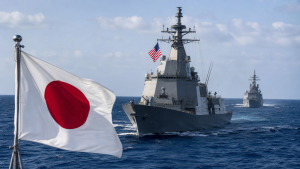
The Indo-Pacific’s security architecture combines treaty alliances, strategic dialogues and defence-technology cooperation. These partnerships address maritime security, deterrence, emerging technologies and practical coordination, while differing in their membership, legal status and scope.
Key Bilateral Security Alliances
Bilateral alliances, particularly those involving the United States, support defence planning and military cooperation across the region. Their arrangements include treaty commitments, joint exercises, strategic consultations and cooperation on defence capabilities.
- US–Japan Alliance: The 1960 Treaty of Mutual Cooperation and Security is its foundation. Japan hosts a significant US military presence, including the US Seventh Fleet. The partners conduct regular exercises and cooperate on missile defence, cyber security, intelligence sharing and advanced defence technologies.
- US–Republic of Korea Alliance: Established by the 1953 Mutual Defense Treaty, the alliance addresses security challenges on the Korean Peninsula. It includes a Combined Forces Command and the deployment of US forces in South Korea. Cooperation includes ballistic missile defence and the Terminal High Altitude Area Defense (THAAD) system.
- US–Australia Alliance: The 1951 Australia, New Zealand, United States Security Treaty (ANZUS Treaty) underpins this partnership. Defence cooperation includes US Force Posture Initiatives, including the rotational deployment of US Marines in Darwin. Maritime security, counter-terrorism and regional stability are among its focus areas.
Multilateral Security Groupings
Multilateral forums support dialogue and practical cooperation beyond treaty alliances. Their work ranges from maritime security and disaster relief to emerging technologies and other shared security concerns.
- Quad: The Quadrilateral Security Dialogue is an informal grouping of Australia, India, Japan and the United States. Its areas of focus include maritime security, humanitarian assistance and disaster relief (HADR), critical and emerging technologies, and cyber security. Its members also participate in the Malabar naval exercise.
- AUKUS: Announced in 2021, this security partnership brings together Australia, the United Kingdom and the United States. Pillar 1 supports Australia’s acquisition of nuclear-powered submarine (SSN) capability. Pillar 2 covers advanced capabilities, including artificial intelligence, quantum technologies, undersea capabilities, cyber, electronic warfare and hypersonic technologies.
- ADMM-Plus: The ASEAN Defence Ministers’ Meeting-Plus includes the ten ASEAN member states and eight Dialogue Partners: Australia, China, India, Japan, New Zealand, the Republic of Korea, Russia and the United States. It provides a forum for regional defence dialogue and practical cooperation in areas such as maritime security, counter-terrorism and HADR.
Defence Cooperation and Technologies
Defence partnerships also involve joint development, production and sharing of equipment and technical information. Such cooperation can support supply security, strengthen industrial capacity and improve interoperability.
- Operation Supercharge: This US–Japan initiative aims to accelerate cooperation on defence equipment and technology. Its objectives include securing defence supplies, strengthening industrial bases and meeting rising demand for advanced military hardware.
- AIM-120 AMRAAM: The Advanced Medium-Range Air-to-Air Missile is used by F-35 Joint Strike Fighters operated by both the United States and Japan. It uses active transmit-and-receive radar guidance. For long-range engagements, inertial navigation guides the missile along an interception course based on pre-launch target information.
- AMRAAM guidance: Once its active radar guides it to the target, the missile can operate in fire-and-forget mode, allowing aircrew to engage multiple targets. To counter jamming, it can switch from active radar homing to passive homing on signals from target aircraft.
- SM-3 Block IIA: This interceptor missile is part of a joint US–Japan programme and is a component of ballistic missile defence systems. The partners are sharing technical information to enhance its production.
Strategic Concepts
Geographical and operational concepts help explain how regional partnerships approach deterrence and defence. The First Island Chain is a strategic geography; denial defence describes an approach to preventing an adversary from achieving its objectives.
- First Island Chain: This chain of archipelagos extends from the Kuril Islands through Japan, Taiwan, the Philippines and Borneo to the Malay Peninsula. It has strategic significance for deterrence and denial defence in the Indo-Pacific.
- Denial defence: This approach seeks to prevent an adversary from achieving its objectives by making aggression costly, rather than relying solely on counter-offensives. It can involve forward deployment and layered defensive capabilities.
Key Prelims Takeaways
- Treaty dates: The US–Japan security treaty dates to 1960; the US–ROK Mutual Defense Treaty to 1953; and the ANZUS Treaty to 1951.
- Quad: Australia, India, Japan and the United States participate in this informal dialogue.
- AUKUS: Its members are Australia, the United Kingdom and the United States; Pillar 1 concerns Australia’s nuclear-powered submarine capability.
- ADMM-Plus: The forum comprises ASEAN’s ten members and eight Dialogue Partners.
- AMRAAM: The AIM-120 uses active radar guidance and can operate in fire-and-forget mode.
- SM-3 Block IIA: The interceptor missile is a joint US–Japan programme.
- First Island Chain: This geographical concept is associated with regional deterrence and denial defence.
Recent Context
On October 28, 2026, Japan and the United States agreed to establish a facility in Japan for the final assembly and inspection of AMRAAMs under Operation Supercharge. Announced after talks at ADMM-Plus in Cebu, the agreement also covers cyber cooperation and advanced joint exercises; the facility’s location and timeline have not been disclosed.
| Related | |
|---|---|