Major Types of Scientific Balloons and Their Applications
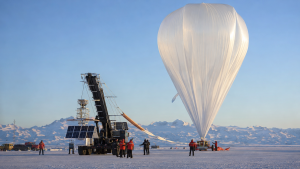
Scientific balloons are uncrewed, lighter-than-air platforms used to carry instruments into the upper atmosphere. They provide comparatively accessible platforms for atmospheric research, astronomy, Earth observation and testing technologies, especially in the stratosphere.
Principles of Balloon Flight
A scientific balloon rises when the buoyant force from the air it displaces exceeds the combined weight of its envelope, lifting gas and payload. Helium and hydrogen provide lift because they are less dense than air. As a balloon ascends, the surrounding air becomes less dense, reducing buoyancy until the upward force balances the balloon’s weight. It then reaches a float altitude or altitude range. Altitude management depends on the balloon’s design. Some flights use ballast, which can be released to help the balloon rise, or vent lifting gas to descend. In zero-pressure designs, gas may also escape as the envelope expands. Scientific balloons commonly operate in the stratosphere, roughly 20–50 kilometres above Earth, where they can carry instruments above much of the lower atmosphere.
Major Types of Scientific Balloons
Zero-Pressure Balloons
Zero-pressure balloons (ZPBs) have an opening at the bottom of the envelope. During ascent, lifting gas expands as external pressure falls, and excess gas can escape through the opening. This helps prevent overpressure. Often made from thin polyethylene film, they are partially inflated at launch and take on a characteristic shape at float altitude. After sunset, cooling causes the lifting gas to contract. The balloon may lose altitude unless ballast is released to compensate. This limits many ZPB flights to days or weeks, although flight duration depends on mission design and operating conditions. ZPBs are used for atmospheric sampling, cosmic-ray measurements and astronomical observations.
Super-Pressure Balloons
Super-pressure balloons (SPBs) have a sealed, stronger envelope designed to constrain its volume. As ambient pressure and lifting-gas temperature change, the envelope helps keep its volume relatively constant, limiting the gas loss associated with an open design. The balloon’s altitude stabilises when declining atmospheric density reduces buoyant force to balance its weight. The volume constraint requires stronger envelope materials than those used for non-pressurised balloons. SPBs can support long-duration flights lasting weeks or months, depending on the mission and operating conditions. They are suited to sustained observations and scientific or experimental payloads; Red Balloon Aerospace’s VISTA platform uses super-pressure balloon technology.
Long-Duration and Hot-Air Balloons
Long-duration balloon (LDB) describes a mission goal, not a separate structural type. Such missions aim to remain aloft for weeks or months and may use SPBs or advanced ZPBs with ballast-management systems. Launch locations and stratospheric wind patterns can support extended flights, including missions that travel over large distances. Hot-air balloons, also called Montgolfières, rise because heated air inside the envelope is less dense than the surrounding air. A burner, typically fuelled by propane, heats the air. Their fuel needs and comparatively limited altitude and duration make them less common for high-altitude science, though they can support lower-altitude atmospheric studies and technology demonstrations.
Lifting Gases and Envelope Materials
Helium is inert and non-flammable, making it the preferred lifting gas for many scientific missions, although it is more expensive. Hydrogen is cheaper and provides slightly more lift, but its flammability requires stringent safety measures. Envelope materials must be lightweight while withstanding low temperatures and changing pressure. Polyethylene film is widely used in ZPBs. SPBs need stronger materials to contain pressure; Mylar, also known as BoPET (biaxially oriented polyethylene terephthalate), is used in some balloon applications. Advanced composites are also being developed for greater durability in extended missions.
Applications of Scientific Balloons
- Atmospheric research: Instruments measure temperature, pressure, humidity, winds, aerosols, greenhouse gases and ozone. These observations support studies of stratospheric chemistry and atmospheric processes such as polar vortices.
- Astronomy and astrophysics: Telescopes and detectors carried above much of the atmosphere can observe X-ray, gamma-ray and infrared phenomena that are absorbed or obscured at lower altitudes. Balloons also carry instruments for cosmic-ray studies.
- Earth observation: Stable platforms can collect high-resolution imagery and support mapping and environmental monitoring, including observations of pollutants, volcanic plumes and forest fires.
- Technology testing: The near-space environment provides a platform for testing scientific instruments, sensors and spacecraft components before possible satellite deployment.
- Communications and monitoring: Experimental communication relays and surveillance sensors can be carried on balloons. Such payloads may support disaster-management applications.
Key Prelims Takeaways
- Scientific balloons are uncrewed, lighter-than-air platforms used for research, observation and technology testing.
- Buoyancy provides lift; scientific balloon missions commonly operate in the stratosphere, roughly 20–50 kilometres above Earth.
- ZPBs have an open bottom, can vent expanding gas and may require ballast release as lifting gas cools.
- SPBs use sealed, stronger envelopes to constrain volume and help maintain altitude over extended flights.
- LDB refers to a mission class, not a balloon structure; missions may use SPBs or advanced ZPBs.
- Helium is non-flammable; hydrogen offers slightly more lift but is flammable. Balloon applications include atmospheric research, astronomy and Earth observation.
Recent Context
Red Balloon Aerospace conducted Mission SANA in May 2026, launching an indigenous super-pressure balloon that reached about 25 kilometres with commercial payloads. The company plans Mission AURA launches from South India between December 2026 and February 2027, with platforms designed to operate at about 20–25 kilometres for scientific, communication and monitoring applications.
| Related | |
|---|---|