Major Fungal Groups and Their Ecological Roles
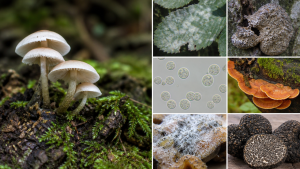
Fungi are eukaryotic organisms distinct from plants and animals. They obtain nutrients by absorption and usually have chitinous cell walls. Their roles range from decomposing organic matter and supporting plant growth to causing disease and supplying compounds used in food, medicine and biotechnology.
Characteristics of Fungi
- Nutrition: Fungi are heterotrophs. They secrete enzymes onto a food source, digest organic material externally and absorb the resulting nutrients.
- Structure: Many fungi consist of thread-like hyphae; a network of hyphae forms the mycelium, the main vegetative body. Yeasts are unicellular.
- Cell walls: Fungal cell walls typically contain chitin, a structural polysaccharide.
- Reproduction: Fungi reproduce sexually and asexually, commonly by spores that can disperse to new habitats.
Major Groups of Fungi
Major groups are distinguished by their reproductive structures and other characteristics. Zygomycota is a traditional grouping; the other groups below are commonly presented as major fungal phyla.
- Chytridiomycota (chytrids): Often regarded as an early-diverging fungal group, chytrids produce motile zoospores with a single posterior flagellum. They are common in aquatic and moist habitats. Some decompose keratin or chitin, while others are parasites. Batrachochytrium dendrobatidis causes chytridiomycosis, associated with declines in amphibian populations.
- Zygomycota (conjugated fungi): This traditional grouping includes bread moulds such as Rhizopus stolonifer. Many are decomposers of soil, plant matter and dung; some parasitise insects or plants. Their hyphae are commonly coenocytic, lacking cross-walls, and sexual reproduction forms thick-walled zygospores. Some species are used in Asian food fermentations.
- Ascomycota (sac fungi): The largest fungal phylum, it includes more than 64,000 species, or about 75% of described fungi. Yeasts, morels, truffles and powdery mildews are examples. Sexual spores, called ascospores, form inside sac-like asci; asexual reproduction can occur through conidia. Members include decomposers, symbionts and pathogens.
- Basidiomycota (club fungi): This diverse group includes mushrooms, puffballs, bracket fungi, rusts and smuts. Club-shaped basidia produce basidiospores externally. Many species break down wood, including lignin, and some form associations with tree roots. Others cause rust and smut diseases in plants.
- Glomeromycota: These fungi form arbuscular mycorrhizae with the roots of most land plants. Branched arbuscules within root cells enable nutrient exchange, while some fungi also form storage structures called vesicles. They depend on host plants for carbohydrates and can improve plant uptake of water and minerals, particularly phosphorus and nitrogen.
Ecological Roles
- Decomposition and nutrient cycling: Fungi break down dead leaves, wood, animal remains and other organic matter. Decomposition returns nutrients to ecosystems and makes fungi important contributors to the carbon cycle and soil fertility.
- Mycorrhizal partnerships: In these associations, fungal hyphae extend the effective area through which plant roots access water and nutrients, especially phosphorus and nitrogen. Plants supply carbohydrates produced by photosynthesis. In ectomycorrhizae, the fungus forms a sheath around roots and grows between root cells; in endomycorrhizae, it enters root cells.
- Lichens: A lichen is an association between a fungus, often an ascomycete, and a photosynthetic alga or cyanobacterium. The fungus provides protection and helps absorb water and minerals; the photosynthetic partner supplies food. Lichens can colonise bare surfaces such as rocks and act as pioneer organisms.
- Endophytes: These fungi live within healthy plant tissues without causing visible disease. They may improve plant growth, stress tolerance or resistance to pathogens, and produce secondary metabolites. Some endophytes persist throughout a plant’s life cycle; others are transient. Transmission can occur from parent to offspring or between plants through spores.
- Pathogens and ecosystem health: Fungi cause diseases in plants, animals and humans. Crop rusts and smuts, amphibian chytridiomycosis, candidiasis and ringworm illustrate their effects. Disease can alter populations and affect ecosystem health and biodiversity.
Economic and Industrial Significance
- Food and fermentation: Edible mushrooms include button, shiitake and portobello varieties. Saccharomyces cerevisiae is used in bread-making and in producing alcoholic beverages; moulds are also used to make cheeses such as blue cheese.
- Medicines: The mould Penicillium is associated with penicillin production. Fungi also provide compounds used in medicines, including cyclosporine, an immunosuppressant, and lovastatin, a cholesterol-lowering drug.
- Biotechnology: Fungi supply enzymes, organic acids and other industrial compounds. Their ability to break down pollutants is used in bioremediation, and some are developed as biopesticides.
- Research: The fungus Neurospora crassa has contributed to genetic and biological research.
Key Prelims Takeaways
- Fungi are absorptive heterotrophs with cell walls that typically contain chitin.
- Chytrids produce flagellated, motile zoospores; some are amphibian pathogens.
- Ascomycota produce ascospores inside asci; Basidiomycota produce basidiospores on basidia.
- Arbuscular mycorrhizae help plants acquire water and nutrients, particularly phosphorus and nitrogen.
- Lichens associate a fungus with an alga or cyanobacterium; endophytes inhabit plant tissues without visible disease.
- Fungi support decomposition, nutrient cycling, ecosystem health and biodiversity, while also causing disease.
Recent Context
In October 2026, Manipur scientist Dr Laishram Shantikumar Singh led the discovery of Mollisia sokpayensia in the Sikkim Himalaya. Isolated from the rhizome of rare Panax sokpayensis, the endophyte was documented in Fungal Diversity, Volume 136. Its metabolites may aid drug discovery, while laboratory cultivation could reduce harvesting pressure on the medicinal plant.
| Related | |
|---|---|