Important Maritime Security Initiatives in the Bay of Bengal
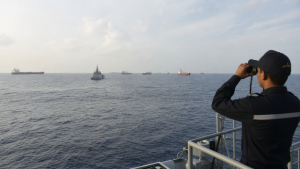
The Bay of Bengal links South and Southeast Asia and supports major trade, energy flows and coastal livelihoods. Its security depends on maritime domain awareness, effective regional coordination and the ability of states to work together against conventional and non-traditional threats.
Strategic Significance of the Bay of Bengal
The Bay of Bengal is the northeastern part of the Indian Ocean, bordered by India, Bangladesh, Myanmar, Sri Lanka, Thailand, Malaysia and Indonesia. It is a gateway for global trade and energy flows, including shipments from the Middle East to East Asia. The region also contains substantial untapped hydrocarbon reserves and supports rich marine biodiversity and fisheries. Its waters are central to the trade, sustenance and strategic access of littoral states. Approximately 25% of global trade traffic passes through the region, making maritime stability important to both regional economies and wider supply routes.
Regional Maritime Cooperation Frameworks
Regional institutions provide forums for dialogue, information exchange and cooperation on security challenges. Their roles and membership differ:
- BIMSTEC: The Bay of Bengal Initiative for Multi-Sectoral Technical and Economic Cooperation was formed in 1997. Its seven members are Bangladesh, Bhutan, India, Nepal, Sri Lanka, Myanmar and Thailand. Bangladesh, Bhutan, India, Nepal and Sri Lanka are South Asian members; Myanmar and Thailand are from Southeast Asia. The permanent secretariat is in Dhaka, established in 2014. Maritime security cooperation seeks to improve operational coordination and interoperability among members.
- Indian Ocean Naval Symposium (IONS): Launched by India in 2008, IONS is a voluntary initiative bringing together navies of Indian Ocean littoral states. It provides a forum to discuss shared maritime issues, foster friendly relationships and facilitate interaction and information-sharing between navies.
- Indian Ocean Rim Association (IORA): Established in 1997 to promote sustained growth and balanced development in the Indian Ocean region, IORA identifies Maritime Safety and Security as one of its six priority areas. Cooperation includes addressing piracy and illegal fishing, as well as search and rescue.
- Quadrilateral Security Dialogue (Quad): Comprising India, the United States, Japan and Australia, the Quad promotes a free, open and inclusive Indo-Pacific. Its work on maritime domain awareness and information-sharing can also support security in the Bay of Bengal.
India’s Maritime Vision and Security Measures
India contributes to regional maritime security through a combination of policy, information-sharing and coastal protection. These efforts support coordination with partners as well as the security of India’s own maritime zones and assets.
- SAGAR: Launched in 2015, Security and Growth for All in the Region is India’s overarching maritime vision. It emphasizes cooperative use of the oceans and a net security provider role, with attention to maritime security, capacity-building, disaster response and economic prosperity in the Indian Ocean Region.
- Information Fusion Centre – Indian Ocean Region (IFC-IOR): Established at Gurugram in 2018, the centre collates, analyses and shares maritime information with partner nations. By tracking shipping and identifying suspicious activity, it strengthens maritime domain awareness. Liaison officers from partner countries facilitate information exchange.
- Coastal security: India strengthened its coastal security apparatus after the 2008 Mumbai attacks. The Indian Navy is responsible for overall maritime security, including coastal and offshore security, while the Indian Coast Guard is responsible for coastal security in territorial waters. Sagar Prahari Bal units help protect naval assets and bases.
Exercises and Operational Cooperation
Naval exercises and coordinated patrols build familiarity, operational readiness and interoperability. They also provide opportunities to share practices and coordinate responses to maritime threats.
- Exercise MALABAR: Began in 1992 as a bilateral exercise between India and the United States. Japan joined permanently in 2015 and Australia in 2020. The multilateral exercise regularly takes place in the Bay of Bengal and includes complex maritime operations.
- SIMBEX: The annual Singapore-India Maritime Bilateral Exercise involves the Indian Navy and Republic of Singapore Navy, with a focus on advanced naval warfare exercises and humanitarian assistance.
- SLINEX: The Sri Lanka-India Naval Exercise aims to build mutual understanding and interoperability between the two navies and enable the exchange of best practices.
- Coordinated Patrols (CORPAT): India conducts patrols with Bay of Bengal littoral states, including Bangladesh, Myanmar, Thailand and Indonesia. They support information-sharing and efforts against illegal, unreported and unregulated fishing, drug trafficking and piracy, as well as disaster-response coordination.
Persistent Maritime Security Challenges
Security initiatives must address threats that affect navigation, coastal communities and the marine environment. Regional coordination is especially relevant where illegal activity or emergencies extend beyond one state’s waters.
- Piracy and armed robbery: Threats have declined but persist in some areas.
- IUU fishing: Illegal, unreported and unregulated fishing depletes marine resources and harms livelihoods.
- Maritime terrorism: Non-state actors may exploit maritime routes.
- Smuggling and trafficking: Maritime routes can be used for narcotics, arms and human trafficking.
- Marine pollution: Oil spills, plastic waste and industrial discharge threaten marine ecosystems.
- Natural disasters: Cyclones and tsunamis require strong humanitarian assistance and disaster relief (HADR) capabilities.
Key Prelims Takeaways
- The Bay of Bengal is a major trade and energy corridor; approximately 25% of global trade traffic passes through it.
- BIMSTEC has seven members, and its permanent secretariat is in Dhaka, established in 2014.
- IONS, IORA and BIMSTEC provide distinct regional platforms for maritime cooperation.
- SAGAR is India’s maritime vision; IFC-IOR, established at Gurugram in 2018, supports regional maritime domain awareness.
- The Indian Navy leads overall maritime security; the Indian Coast Guard is responsible for coastal security in territorial waters.
- MALABAR, SIMBEX, SLINEX and CORPAT support cooperation and operational readiness. A joint exercise involves forces of one nation; a combined or coalition exercise involves multiple nations.
Recent Context
India is hosting the first joint BIMSTEC maritime security exercise from October 30 to November 3, 2026. All seven members are represented; Bangladesh, Myanmar, Sri Lanka and Thailand have sent naval assets. Activities include HADR, responses to cross-border maritime crime and marine pollution.
| Related | |
|---|---|