Impacts of Volcanic Ash on Aviation and Public Health
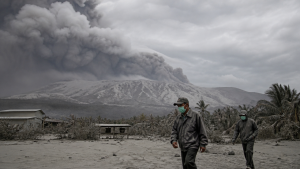
Volcanic ash consists of fine fragments of rock, minerals and volcanic glass that can travel far beyond an eruption site. Its abrasive particles threaten aircraft and can affect respiratory health, eyes, water supplies and food.
Characteristics and Dispersion
Volcanic ash particles are typically irregular, sharp-edged and abrasive. Their composition includes silica, feldspar and iron minerals, and they are denser than ordinary atmospheric dust. Particle sizes range from fine, micron-sized material to larger fragments; ash deposits may include particles from below 2 millimetres to fragments as large as 64 millimetres. Fine ash can remain suspended in the atmosphere for days or weeks, and sometimes months. Its persistence and dispersal depend on eruption intensity and meteorological conditions. Ash may travel hundreds to thousands of kilometres from the volcano, so the area at risk can extend well beyond the immediate eruption zone.
Impacts on Aviation Safety
Ash clouds pose several hazards to aircraft, including damage to engines and airframes and disruption to flight instruments. Jet engines are especially vulnerable: at operating temperatures of about 1,100°C to 1,400°C, silica-rich ash can melt into glass. The molten material may fuse to turbine blades and combustion components, obstructing airflow and causing engine surges or flameout.
- Engine damage: Ingested ash can erode compressor fans, turbine blades and fuel nozzles. Melted ash may solidify on hot components, restrict airflow and cause power loss or engine failure.
- Visibility: Ash plumes can reduce visibility and obscure navigational aids, making instrument flight essential when aircraft are operating in affected conditions.
- Airframe abrasion: High-speed ash impacts can sandblast windscreens, wing leading edges and the fuselage, damaging surfaces and potentially affecting aerodynamic performance.
- System contamination: Ash can clog pitot tubes and produce erroneous airspeed readings. It may also enter ventilation systems and avionics compartments, affecting electronic components.
- Electrical and control effects: Friction between particles can generate static electricity that interferes with radio communications or onboard electrical systems. Ash accumulation on wings and control surfaces can alter their aerodynamic properties and add weight.
Aviation Monitoring and Response
The International Civil Aviation Organization coordinates international responses to volcanic ash hazards. Its system includes nine Volcanic Ash Advisory Centers (VAACs), located in Anchorage, Buenos Aires, Darwin, London, Montreal, Tokyo, Toulouse, Washington and Wellington. Each covers a designated region.
- Advisories: VAACs monitor ash plumes and forecast their movement. Volcanic Ash Advisories provide information on ash-cloud location, altitude and expected movement to meteorological watch offices, air traffic control centres and airlines.
- Airspace decisions: Aviation authorities may impose temporary flight restrictions or reroute traffic to avoid ash-contaminated airspace.
- Aircraft inspection: Following a possible ash encounter, aircraft require inspection and maintenance, including engine borescope examinations and airframe cleaning.
- Pilot procedures: Training covers recognition of ash encounters and emergency actions, such as reducing thrust and making a 180-degree turn to leave an ash cloud.
Public Health and Risk Management
Health effects depend on particle size, ash concentration, exposure duration and individual susceptibility. Fine particles can be inhaled, while ash deposited on surfaces can irritate the eyes and skin or contaminate exposed water and food. People with existing respiratory conditions and others more susceptible to exposure may face greater health effects.
- Respiratory effects: Inhalation can irritate the respiratory tract and cause coughing, wheezing and shortness of breath. Ash exposure may aggravate asthma, bronchitis and emphysema. Prolonged exposure to silica-containing ash can lead to silicosis.
- Eye and skin irritation: Ash can cause redness, itching and a gritty sensation in the eyes, as well as conjunctivitis or corneal abrasions. Skin contact may cause dryness, itching and redness, particularly in people with sensitive skin or existing skin conditions.
- Food and water: Ashfall can contaminate open water sources, crops and livestock feed. Water may be unsafe to drink without appropriate treatment, while ash on produce needs to be washed away.
- Community wellbeing: Prolonged ashfall and the disruption it causes can contribute to stress and anxiety among affected communities.
Risk management relies on timely public warnings about expected ashfall and its health risks. Residents can use N95 respirators or wet cloths to cover the nose and mouth during outdoor activities; goggles or eyeglasses help protect the eyes, and contact lenses are best avoided during ash exposure.
- Protect supplies and homes: Cover water tanks and food, seal doors and windows, and protect sensitive electronics. Wash fruit and vegetables before use.
- Reduce structural risks: Clear ash from roofs where it is safe to do so, as accumulated ash can contribute to roof collapse.
- Prepare and evacuate: Household emergency kits should include water, food, first-aid supplies and protective equipment. Clear danger zones and evacuation plans are important when eruption hazards, including ashfall and pyroclastic flows, are high.
Key Prelims Takeaways
- Volcanic ash is abrasive material made up of rock, mineral and glass fragments, including silica.
- Molten ash can form glass deposits in jet engines, obstructing airflow and causing engine failure.
- ICAO’s nine VAACs issue advisories on ash-cloud location, altitude and forecast movement.
- Ash can damage aircraft surfaces, clog air data sensors and interfere with communications.
- Health effects include respiratory, eye and skin irritation; prolonged silica exposure can lead to silicosis.
- N95 respirators, eye protection and covered water and food supplies are among the protective measures.
Recent Context
On October 30, 2026, Mayon Volcano erupted for nearly six minutes from 11:53 a.m., sending a 3,000-metre ash plume west-southwest. PHIVOLCS raised the alert from Level 2 to Level 3. On October 31, another ash emission rose 200 metres above the crater; civil aviation was advised to avoid the summit.
| Related | |
|---|---|