Point out the negative externalities of industrial monoculture. How can agroecology mitigate these ecological crises while ensuring long-term soil health? Critically discuss.
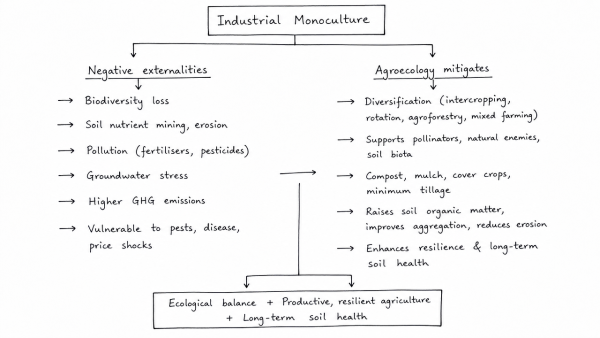
Industrial monoculture raises output in the short term, but its negative externalities are large: biodiversity loss from habitat simplification, soil nutrient mining and erosion, pollution from fertilisers and pesticides, groundwater stress from water-intensive crops, higher greenhouse-gas emissions due to reduced soil carbon, and economic vulnerability to pests, disease and price shocks.
Ecological crisis
Agroecology counters these impacts by diversifying farms through intercropping, rotation, agroforestry and mixed farming, which support pollinators, natural enemies and soil biota. Composting, mulching, cover crops and minimum tillage raise soil organic matter, improve aggregation, reduce erosion and strengthen nutrient cycling. Biological pest control and nutrient recycling cut chemical dependence, lowering runoff and toxicity, while better ground cover and soil porosity improve moisture retention and climate resilience.
Critical view
However, agroecology is not a instant replacement for industrial farming: transition costs, possible short-term yield declines, and weak credit, extension and market support can slow adoption. Its success depends on local adaptation, secure land tenure, and policy support for extension, procurement and risk-sharing.
Thus, agroecology offers a viable long-term pathway to reconcile productivity with resilient soils and ecosystems, but only if backed by enabling institutions and a phased transition from monoculture-dependent agriculture.