Active Protection Systems and Countermeasures for Armoured Vehicles
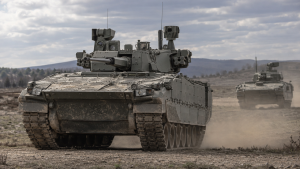
Armoured vehicle survivability depends on layered protection against increasingly capable anti-tank weapons. Passive and reactive armour strengthen the vehicle itself, while Active Protection Systems detect and counter threats before impact. Understanding how these measures work—and how missiles seek to defeat them—is relevant to military technology and defence preparedness.
Understanding Armoured Vehicle Protection
The purpose of vehicle protection is to safeguard the crew and internal components from battlefield threats. Traditional designs relied mainly on passive armour, but advanced anti-tank guided missiles (ATGMs) and rocket-propelled grenades (RPGs) have increased the demands on protection. Some warheads are designed to penetrate armour that would stop less advanced munitions. Modern protection therefore uses several complementary layers. Armour can absorb or disrupt a projectile, reactive systems can respond to impact, and Active Protection Systems (APS) can detect and counter a threat before it reaches the vehicle. These measures address different stages of an attack; none should be treated as a substitute for every other layer.
Passive and Reactive Armour
Passive armour consists of fixed, non-energetic layers that absorb or deflect the energy of incoming threats. Hardened steel, aluminium alloys and composite ceramics are among the materials used. Increasing passive protection against powerful munitions can add substantial weight, creating a trade-off between protection and vehicle mobility. Reactive armour responds dynamically when struck. Two important types are:
- Explosive Reactive Armour (ERA): ERA tiles contain an explosive layer between metal plates. A shaped-charge impact triggers the explosive, driving the plates outwards and disrupting the penetrating jet. ERA is effective against shaped charges, but tandem-charge warheads are designed to challenge it. Its explosive response can also pose a risk to nearby infantry.
- Non-Explosive Reactive Armour (NERA) or Non-Energetic Reactive Armour (NxRA): These systems use inert layers that deform on impact. The deformation can shear a penetrating jet without an explosive blast, reducing collateral risk and allowing better performance against multiple hits than ERA.
Active Protection Systems: Principles and Types
An APS detects an incoming munition and responds before it strikes the vehicle. A typical system combines sensors—such as radar or electro-optical devices—with a fire-control unit and countermeasures. The system must detect and track the threat, assess its trajectory and trigger an appropriate response. APS measures are broadly divided into hard-kill and soft-kill systems. Hard-kill systems physically intercept an incoming munition; soft-kill measures seek to disrupt or mislead its guidance. Some protection configurations combine different measures with conventional armour, creating more than one opportunity to defeat a threat.
- Hard-kill APS: Sensors identify and track an incoming projectile, and a computer determines an interception point. The system then launches a counter-projectile or directs an explosive charge to destroy or deflect the threat away from the vehicle. Examples include Trophy, Arena, Iron Fist and Afganit.
- Soft-kill APS: These measures do not physically intercept the munition. They instead interfere with its ability to locate or track the target, using electronic jamming, laser dazzling or obscurants.
- Examples of soft-kill measures: Infrared jammers can confuse the seeker heads of infrared-guided missiles. Laser dazzlers can disrupt optical sensors or laser seekers. Multi-spectral smoke or aerosols can obscure the vehicle across visible, infrared and radar spectra.
Shtora-1 combines infrared jammers, laser-warning receivers and smoke grenade launchers. India’s Vehicle Integrated Radio Jammer and Survivability System (VIRSS) is a soft-kill example, while South Africa’s LEDS-150 integrates laser warning and multi-spectral smoke. These systems illustrate how countermeasures can target different guidance methods.
ATGM Guidance and Countermeasures
ATGMs use different guidance methods and warhead designs to defeat vehicle protection. Tandem-charge warheads are intended to overcome reactive armour: a precursor charge detonates the ERA, allowing the main shaped charge to strike the underlying armour. The Milan-2T uses a tandem-charge warhead. Laser beam-riding guidance works differently from semi-active laser homing. The missile enters a laser beam aimed at the target and uses onboard controls to remain within the beam as it travels towards impact. This method is used by Bagheera AT1.
- Beam-riding and detection: Beam-riding missiles are potentially harder for laser-warning receivers to detect than semi-active laser-homing missiles because they require a lower-intensity signal.
- Countermeasure implications: Hard-kill APS aim to intercept the missile physically, while soft-kill measures seek to disrupt or mislead its guidance. Armour and reactive systems provide additional layers if a threat is not defeated earlier.
- Indian inventory: India’s anti-tank missile inventory includes Milan-2T, Konkurs-M systems and Spike missiles.
Battlefield Survivability and Defence Preparedness
The interaction between armour, APS and ATGM design is an ongoing contest. Tandem charges challenge ERA, while hard-kill and soft-kill systems address threats through different mechanisms. Effective battlefield survivability therefore depends on matching protection to the threat and combining measures rather than relying on a single technology. For defence preparedness, the distinction between defeating a missile physically and disrupting its guidance is important. Vehicle protection also has to account for crew safety, mobility and the operational environment. Indigenous development, maintenance and lifecycle support are relevant to sustaining these capabilities, alongside the performance of the equipment itself.
Key Prelims Takeaways
- Passive armour: Uses fixed materials to absorb or deflect incoming threats.
- ERA: Uses an explosive layer and moving plates to disrupt a shaped-charge jet.
- NERA/NxRA: Deforms on impact to shear a penetrating jet without an explosive blast.
- Hard-kill APS: Physically intercepts incoming munitions; Trophy and Arena are examples.
- Soft-kill APS: Seeks to disrupt guidance through jamming, dazzling or obscurants; Shtora-1 and VIRSS are examples.
- Tandem charge: A precursor charge is intended to defeat ERA before the main shaped charge strikes.
Recent Context
Adani Defence & Aerospace demonstrated Bagheera AT1 at Pokhran Field Firing Ranges in trials conducted under a No Cost No Commitment arrangement. The demonstration included day-and-night engagements, a two-missile salvo against an armoured target and an engagement against an aerial target at extended range.
| Related | |
|---|---|