Standards and Regulations for Packaged Drinking Water in India
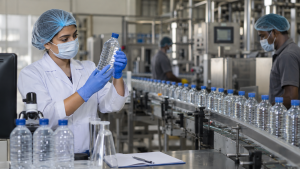
Packaged drinking water is regulated as a food product in India, with safety requirements covering its source, treatment, quality and sale. The framework distinguishes treated drinking water from natural mineral water and combines national standards with licensing, testing and inspection.
Regulatory Framework: FSSAI and the FSSA, 2006
The Food Safety and Standards Act (FSSA), 2006, consolidated seven earlier food-safety laws into a single legal framework. It brought responsibilities previously spread across different laws and government departments under a unified system, with the Food Safety and Standards Authority of India (FSSAI) as the statutory food-safety regulator. The Act empowers FSSAI to regulate the manufacture, storage, distribution, sale and import of food articles, including packaged water. Its regulatory functions include setting standards, licensing food businesses and enforcing compliance through inspections and testing.
- Standards: FSSAI develops requirements for food products, including packaged drinking water.
- Licensing and oversight: Food businesses must meet applicable licensing and regulatory requirements.
- Standard-setting process: Scientific committees and panels prepare standards. Drafts are opened for stakeholder comments and WTO notification before finalisation and publication in the Gazette of India.
Types of Packaged Water and Applicable Standards
FSSAI distinguishes Packaged Drinking Water (other than Mineral Water) from Packaged Natural Mineral Water. The categories differ in source and treatment, and have separate Bureau of Indian Standards (BIS) specifications.
- Packaged Drinking Water: It may come from a potable source such as groundwater, municipal supply or surface water. It is treated to meet prescribed requirements; treatment may include reverse osmosis (RO), ultraviolet (UV) sterilisation and ozonation. The relevant BIS specification is IS 14543.
- Packaged Natural Mineral Water: It comes from a protected underground source and contains naturally occurring minerals. Processing is limited, principally to preserve its natural composition and taste. Its BIS specification is IS 13428.
- Relationship with BIS certification: Mandatory BIS certification for packaged drinking water and mineral water was removed from October 17, 2024, making certification voluntary.
- FSSAI testing requirements: From January 1, 2026, FSSAI’s testing scheme requires manufacturers to meet the quality benchmarks of IS 14543 or IS 13428, as applicable, to obtain and maintain an FSSAI licence.
Quality Parameters and Health Significance
Packaged drinking water must meet physical, chemical and microbiological requirements. IS 14543 covers parameters including pH, total dissolved solids (TDS), heavy metals, pesticides and microbiological contaminants. These requirements are distinct from those for ordinary tap water under IS 10500.
- Bromate: The prescribed limit is 10 micrograms per litre (µg/L), consistent with World Health Organization guidelines. Bromate can form during ozonation if the process is not carefully controlled. Prolonged exposure is associated with potential carcinogenic risks.
- Polynuclear aromatic hydrocarbons (PAHs): Indian standards require PAHs to be non-detectable in packaged drinking water. They may enter water through environmental pollution or pipe coatings; certain PAHs are associated with carcinogenic risks.
- Public-health purpose: Limits on chemical and microbiological contaminants help make water safe for consumption. Monitoring both the water and its packaging is relevant to quality assurance.
Enforcement, Inspection and Industry Compliance
FSSA enforcement arrangements provide for inspections, sample collection and laboratory analysis. Food Safety Officers may inspect commercial food premises and collect samples for examination by a Food Analyst.
- Sample collection: Officers must follow prescribed procedures, including obtaining witnesses, issuing the food business operator a notice in Form V-A, paying for the sample and dividing it into four parts for testing and record-keeping.
- Laboratory examination: A Food Analyst examines the sample. In an appeal, a referral food laboratory may conduct further examination.
- High-risk classification: Since November 2024, packaged drinking water has been classified by FSSAI as a “high-risk” food product.
- Stricter oversight: The classification entails pre-licensing inspections, annual inspections and regular testing of water and packaging. Centrally licensed manufacturers also require annual third-party food-safety audits.
- Compliance implications: Manufacturers must maintain consistent product quality and meet applicable standards, testing and licensing requirements. Inspection and laboratory findings can identify non-compliance and support enforcement action.
The framework links public-health protection to quality assurance and industry compliance. Clear standards and routine testing help identify unsafe products, while inspections and licensing make manufacturers accountable for meeting the requirements. The separate standards for treated drinking water and natural mineral water also make correct product classification important for compliance.
Key Prelims Takeaways
- FSSA, 2006: Consolidated seven earlier food-safety laws under a single framework.
- Regulator: FSSAI regulates packaged water through standards, licensing, inspections and testing.
- Standards: IS 14543 applies to Packaged Drinking Water; IS 13428 applies to Packaged Natural Mineral Water.
- BIS certification: Mandatory certification was removed from October 17, 2024; FSSAI’s testing scheme took effect on January 1, 2026.
- Contaminant limits: Bromate is limited to 10 µg/L, while PAHs must be non-detectable.
- High-risk category: Packaged drinking water has been classified as high-risk since November 2024, with stricter inspection and testing requirements.
Recent Context
On November 22, 2026, FSSAI sanctioned prosecution against Bisleri International Pvt Ltd over a sample from a September 2025 batch produced at its Goa facility. The sample was initially found non-compliant with bromate limits; a referral laboratory later declared it unsafe after detecting PAHs. Bisleri said on November 23 that the water was safe, disputed aspects of the case and would cooperate.
| Related | |
|---|---|