Voyager 1 Nears One Light-Day from Earth
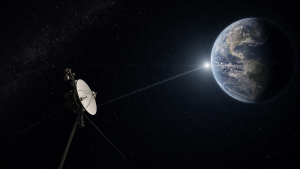
NASA’s Voyager 1 is projected to become the first human-made object one light-day from Earth at 10:16 UTC on 18 November 2026, about 25.902 billion kilometres (16.094 billion miles) away.
Distance and communication delay
As of 3 November 2026, Voyager 1 was about 25.86 billion kilometres from Earth; its radio signal took 23 hours, 57 minutes and 49 seconds to reach Earth. A command will take nearly 24 hours to arrive, with a reply requiring about another 24 hours, making a round trip roughly two days.
Spacecraft status and mission
In October 2026, the Deep Space Network failed to detect Voyager 1’s signal during scheduled communication attempts, and NASA lost contact for 48 hours. Contact was restored on 20 October. Engineers at NASA Jet Propulsion Laboratory traced the interruption to a group of thrusters going offline; backup thrusters took over and triggered the spacecraft’s fault protection system. NASA is replacing power-hungry heating devices to extend the mission. Launched on 5 September 1977, Voyager 1 is travelling through interstellar space at about 61,000 kilometres per hour towards Gliese 445 (AC+79 3888) in Ursa Minor. Its twin, Voyager 2, is expected to reach one light-day from Earth in November 2035.
Important Facts for Exams
- Titan encounter choice: Voyager 1’s trajectory prioritised a Titan flyby over Pluto because Titan was known to have a substantial atmosphere.
- Heliopause crossing: Voyager 1 crossed the heliopause into interstellar space on 25 August 2012, becoming the first spacecraft to do so.
- RTG power decline: Voyager 1’s RTG output falls over time as its fuel decays and its thermocouples degrade.
- Data buffering: When communication is unavailable, Voyager 1’s digital tape recorder can store about 64 megabytes for later transmission.
| Related | |
|---|---|