Types of Hydropower Projects and Their Functions
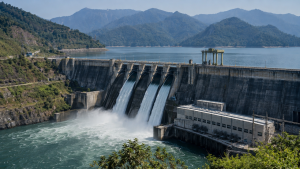
Hydropower projects convert the energy of flowing or falling water into electricity. Their designs differ in how they store and direct water, shaping their generation patterns and roles in energy storage, grid balancing and sustainable power generation.
Conventional Dam and Reservoir-Based Hydropower
Conventional dam hydropower stores river water in a reservoir and releases it through turbines to generate electricity. The process converts the potential energy of stored water into kinetic energy, then mechanical energy and, finally, electrical energy.
- A dam impounds river water to form a reservoir. Intake gates control the release of water into a penstock, a large pipe or conduit leading to the turbines.
- Water flowing through the penstock turns turbine blades. The turbine is coupled to a generator, which converts the turbine’s mechanical energy into electricity through electromagnetic induction.
- Output depends on the volume of water available and the height difference, or head, between the intake and outflow. Greater flow or head can support greater generation, subject to the plant’s design and operating conditions.
- Reservoir-based stations can increase or reduce generation rapidly, often within seconds or minutes. This dispatch flexibility helps them respond to changes in electricity demand and support grid balancing.
Run-of-River Hydropower
Run-of-river projects use the natural flow of a river and generally have little or no capacity to store water. They divert a portion of the river’s flow through a canal or penstock and direct it to a turbine.
- Unlike a large reservoir scheme, a run-of-river project does not depend on substantial upstream water impoundment. The diverted water drives the turbine and is then returned downstream.
- These facilities can provide a continuous supply of electricity when river flow is adequate. Their output, however, varies with natural and seasonal changes in river flow.
- Because they generally involve less water storage, run-of-river schemes typically have a lower submergence-related impact than large reservoir projects. This does not mean that they have no environmental effects.
- Their generation is closely tied to the river’s available flow, so they offer less control over output than reservoir-based stations that can regulate water releases.
Pumped-Storage Hydropower
Pumped-storage hydropower (PSH) is primarily an energy-storage system. It stores surplus electricity as gravitational potential energy and releases that energy as electricity when demand is high.
- A typical PSH facility has two reservoirs at different elevations: an upper reservoir and a lower reservoir.
- During periods of low electricity demand, surplus electricity from the grid powers pumps that move water from the lower reservoir to the upper one. This stores energy in the elevated water.
- When demand rises, water is released from the upper reservoir and flows through turbines back to the lower reservoir, generating electricity.
- PSH therefore operates like a large battery for the grid. It helps balance electricity supply and demand and provides flexibility when power generation and consumption do not coincide.
- Its main function is to shift energy across time: electricity is used for pumping during lower-demand periods, while generation is increased during higher-demand periods.
Cascade Hydropower Systems
A cascade system consists of power stations arranged one after another along a river. It is designed to use the river’s energy multiple times as water flows downstream.
- Water discharged from an upstream station can flow to the reservoir or intake of a downstream station, where it is used again to generate electricity.
- By developing stations at successive points along the river, a cascade can extract energy across different elevations and increase the total generation potential of the river system.
- Stations may operate independently, but coordination can support the overall management of water flows and generation across the river basin.
Common Components and Engineering Aspects
The design and operation of hydropower facilities depend on the relationship between water flow, head and the equipment that converts water energy into electricity.
- Turbines: Rotating machines that convert the energy of moving water into mechanical energy. Francis, Kaplan and Pelton turbines are selected according to factors including water head and flow rate.
- Generators: Coupled to turbines, generators convert mechanical energy into electrical energy through electromagnetic induction.
- Dams: Structures built across rivers to impound water and create reservoirs. Concrete gravity, arch and embankment designs may be used depending on geological conditions and site topography.
- Penstocks: Large pipes or tunnels that convey water from a reservoir or intake structure to the turbines.
- Tunnel ground surveys: Major hydropower tunnels require investigation of ground conditions. Borehole samples and geophysical surveys help inform excavation methods and the design of ground-support systems, contributing to stability and safety.
Key Prelims Takeaways
- Conventional hydropower: Uses a dam and reservoir; generation depends on water volume and head.
- Reservoir-based stations: Can rapidly adjust generation to changing electricity demand.
- Run-of-river projects: Have little or no storage and depend on natural river flow.
- Pumped storage: Pumps water uphill during low demand and generates electricity during high demand.
- Cascade stations: Use river water successively at multiple power stations.
- Grid role: Reservoir flexibility and pumped storage support grid balancing and energy storage.
- Core equipment: Turbines, generators, dams and penstocks perform distinct roles in generation.
Recent Context
China is advancing the 60-GW Medog hydropower project on the lower Yarlung Tsangpo in Tibet, reported to include five cascade stations. India plans the 11,200-MW Siang Upper Multipurpose Project in Arunachal Pradesh; it remains at the pre-feasibility stage and faces concerns over displacement and submergence.
| Related | |
|---|---|