Court of Arbitration for Sport: Structure, Jurisdiction and Functions
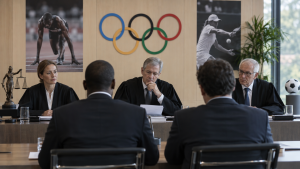
The Court of Arbitration for Sport (CAS) is an international institution that settles sports-related disputes through arbitration. Its specialist divisions hear contractual disputes and appeals against sports-body decisions, while its procedures aim to support independent adjudication and the consistent application of sports rules.
Genesis and Governance
CAS was established by the International Olympic Committee (IOC) in 1984. Concerns about its independence led to reforms in 1994, separating its administration and finances from the IOC and placing oversight with the International Council of Arbitration for Sport (ICAS).
- Paris Agreement: Signed on 22 June 1994, it established ICAS and provided the basis for CAS’s reformed structure. Its signatories included the IOC, the Association of Summer Olympic International Federations (ASOIF), the Association of International Winter Sports Federations (AIWF) and the Association of National Olympic Committees (ANOC).
- ICAS: A foundation under Swiss law, it has 20 members with expertise in arbitration and sports law. Members undertake to perform their functions objectively and independently.
- Oversight: ICAS oversees CAS’s administration and finances and safeguards its institutional independence from any single sports organisation.
- Procedural framework: The Code of Sports-related Arbitration, also called the CAS Code, governs CAS’s organisation and procedures. Its latest version entered into force on 1 July 2025.
Divisions and Organisation
CAS is based in Lausanne, Switzerland, and also has offices in New York City and Sydney. Temporary ad hoc divisions may operate at major sporting events, including the Olympic Games, to deal with disputes requiring rapid resolution.
- Ordinary Arbitration Division: Hears general sports-related disputes as a court of first instance, often involving contracts or commercial arrangements.
- Appeals Arbitration Division: Hears appeals against decisions of sports federations, associations and other sports bodies, where CAS jurisdiction is provided for in the relevant rules or an arbitration agreement.
- Anti-Doping Division: Handles anti-doping matters as a first-instance or sole-instance authority where the applicable rules confer jurisdiction.
- Division leadership: Each division is overseen by a president and deputy presidents, who are members of ICAS.
Jurisdiction and Functions
CAS jurisdiction is not automatic. It depends on consent or a rule that gives CAS authority to hear the dispute. This requirement links the tribunal’s power to the parties’ agreement or the governing rules of the relevant sports body.
- Ordinary arbitration: A dispute may be referred through an arbitration clause in a contract or sports-body statute, or through a specific arbitration agreement made by the parties after the dispute arises.
- Appeals: Federation statutes and regulations may provide for an appeal to CAS. The division commonly hears matters involving disciplinary action, athlete eligibility and sanctions, including doping-related decisions.
- Contractual and commercial matters: Disputes over player transfers, media rights, sponsorship rights and the organisation of sporting events may be heard by the Ordinary Arbitration Division when jurisdiction is established.
- Olympic disputes: Rule 61 of the Olympic Charter provides for disputes connected with the Olympic Games to be submitted to CAS. An ad hoc division can provide expedited procedures during the Games.
CAS interprets and applies sports rules and can overturn decisions made by governing bodies, including on appeal from a body such as the Confederation of African Football (CAF). Its role in dispute resolution therefore includes reviewing whether a sports organisation applied its rules correctly, subject to the scope of CAS’s jurisdiction.
Arbitration Process and Principles
Cases are heard by a sole arbitrator or a panel, commonly comprising three arbitrators. Arbitrators are selected from an approved list and are expected to have relevant legal and arbitration expertise.
- Independence and impartiality: Arbitrators must remain independent and impartial throughout the proceedings. They have an ongoing duty to disclose circumstances that could reasonably raise doubts about either quality.
- Procedural fairness: Parties must receive fair treatment, including an opportunity to present their case. These safeguards are also relevant to the limited grounds on which an award may later be challenged.
- Field-of-play doctrine: Decisions made by match officials during competition are generally not reviewed on appeal. Intervention may be possible where there is clear evidence of bias, malice, bad faith, arbitrariness or legal error.
- Match officials’ authority: The doctrine protects the authority of officials, limits interruptions and supports the finality of competition results. Decisions on match management, such as restarting or abandoning a game, may fall within a referee’s “sole authority.”
Tournament rules on a team’s refusal to play or forfeiture are applied by CAS only if the referee permanently stops the match. Where the referee resumes play, the decision to do so may fall within the referee’s match-management authority and be considered under the field-of-play doctrine.
Challenging CAS Awards
CAS decisions are generally final and binding, and sports organisations generally implement them. An international CAS award seated in Lausanne may be challenged before the Swiss Federal Supreme Court, but the challenge is not a further appeal on the merits.
- Applicable law: Article 190(2) of the Swiss Private International Law Act (PILA) sets out the closed list of grounds for challenging an international arbitral award.
- Tribunal and jurisdiction: A challenge may concern the improper constitution of the arbitral tribunal or an incorrect decision on jurisdiction.
- Scope of decision: A challenge may be brought if the tribunal decided beyond the claims submitted to it or failed to decide a claim.
- Procedural rights and public policy: Grounds include a breach of equal treatment or the right to be heard, and incompatibility of the award with Swiss public policy.
Key Prelims Takeaways
- Established: CAS was created by the IOC in 1984 and reformed in 1994.
- Oversight: ICAS safeguards CAS’s independence and oversees its administration and finances.
- Divisions: The two primary divisions are Ordinary Arbitration and Appeals Arbitration; an Anti-Doping Division also operates.
- Jurisdiction: CAS needs an applicable arbitration agreement or a rule conferring competence.
- Field of play: Match officials’ decisions are generally protected, subject to narrow grounds for intervention.
- Awards: Challenges to international awards go to the Swiss Federal Supreme Court on statutory grounds, not on the merits.
Recent Context
On 24 November 2026, CAS reinstated Senegal as champions of the 2025 Africa Cup of Nations, overturning a CAF Appeal Board decision. It held that tournament forfeiture rules applied only if the referee permanently stopped the match; resuming play fell within the referee’s authority under the field-of-play doctrine.
| Related | |
|---|---|