Major Maritime Security Missions of India
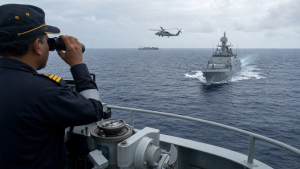
India’s maritime security framework protects its coastline, island territories, offshore assets and sea lines of communication. It combines naval and coast guard operations, coastal policing, surveillance networks and cooperation with regional partners to address conventional and non-traditional threats.
Importance of India’s Maritime Domain
India has a coastline of over 7,500 km and an Exclusive Economic Zone (EEZ) spanning more than 2.3 million square kilometres. Its position in the Indian Ocean Region (IOR) gives maritime security direct importance for trade, energy supplies and regional stability. The source estimates that over 75% of global maritime trade and 50% of global oil consumption pass through the IOR. Maritime risks include piracy and maritime terrorism, as well as illegal, unreported and unregulated (IUU) fishing, smuggling and natural disasters. India’s missions therefore combine deterrence and law enforcement with surveillance, search and rescue, and humanitarian assistance.
Institutions and Security Frameworks
Maritime security is managed through several agencies and coordination mechanisms, with responsibilities extending from defence at sea to law enforcement and coastal surveillance.
- Indian Navy: India’s primary instrument of sea power, responsible for maritime defence, deterrence and protecting national maritime interests.
- Indian Coast Guard (ICG): Established under the Coast Guard Act, 1978, it undertakes coastal surveillance, search and rescue, anti-smuggling and pollution-response duties.
- Marine Police: Supports law enforcement in territorial waters, which extend up to 12 nautical miles from the coast.
- National Committee for Strengthening Maritime and Coastal Security (NCSMCS): Oversees coordination among agencies involved in maritime and coastal security.
- Information Management and Analysis Centre (IMAC): A joint Navy–Coast Guard intelligence hub for maritime domain awareness.
- NC3I Network: The National Command Control Communication and Intelligence Network connects 51 coastal radar stations and 16 ICG and Navy stations for real-time surveillance.
The Coastal Security Scheme, launched in 2005, supports coastal policing through infrastructure and equipment upgrades for Marine Police. SAGAR (Security And Growth for All in the Region), launched in 2015, sets out India’s vision for security and cooperation in the IOR.
Operational Missions and Naval Exercises
India’s maritime missions include patrols, anti-piracy deployments, evacuation and disaster-relief operations, and exercises with partner countries. They protect shipping and offshore interests while supporting cooperation and interoperability.
- Anti-piracy operations: Indian naval ships have operated in the Gulf of Aden and off Somalia since 2008. The source records more than 4,000 ships and 25,000 seafarers protected.
- Humanitarian assistance and disaster relief (HADR): Naval and coast guard assets provide aid during disasters in India and neighbouring countries. Operation Rahat evacuated people from Yemen; Operation Samudra Setu repatriated people during COVID-19.
- Malabar: A naval exercise involving India, the United States, Japan and Australia since 2020.
- SIMBEX and SLINEX: Bilateral naval exercises with Singapore and Sri Lanka, respectively.
- Konkan, Varuna and Indra Navy: Bilateral exercises with the United Kingdom, France and Russia, respectively.
- Milan: A multilateral naval exercise hosted by India.
- Op Sagar Kavach: A coastal security exercise conducted periodically along India’s coastline.
Coastal Security and Capacity Building
India’s coastal security architecture is layered to detect, deter and respond to threats. The first layer is patrolled by the Navy and Coast Guard; Marine Police form the second layer, while State Police, Customs and other land-based agencies provide a further layer of checking and verification.
- Patrolling: The ICG and Marine Police conduct regular coastal security patrols.
- Coordination: The National Maritime Security Coordinator (NMSC) was appointed in 2022 to support a cohesive approach to maritime security.
- Identification and tracking: Fishing boats are subject to mandatory registration, and identity cards are issued to fishermen and coastal populations.
- Indigenous shipbuilding: Make in India and Aatmanirbhar Bharat support domestic design, development and construction of naval platforms and equipment.
- Buy (Indian-IDDM): Under the Defence Acquisition Procedure (DAP) 2020, this category means “Indigenously Designed, Developed and Manufactured.”
- Offshore patrol vessels (OPVs): These ships support maritime surveillance and security, including coastal and offshore patrols, anti-piracy work, HADR and protection of offshore assets.
- Other naval capabilities: Project 75 (India) is a programme for indigenous submarine construction. India operates INS Vikramaditya and the indigenously built INS Vikrant.
Key Prelims Takeaways
- Coastline: India’s coastline is over 7,500 km.
- Coast Guard: Established under the Coast Guard Act, 1978.
- SAGAR: India’s IOR security and cooperation vision, launched in 2015.
- Surveillance: IMAC supports maritime domain awareness; NC3I links coastal radar and ICG/Navy stations.
- Exercises: Malabar involves India, the United States, Japan and Australia; Milan is hosted by India.
- Procurement: Buy (Indian-IDDM) means Indigenously Designed, Developed and Manufactured; the NMSC was appointed in 2022.
Recent Context
Goa Shipyard Limited launched INS Srishti (Yard 1283), the Indian Navy’s fourth Next Generation Offshore Patrol Vessel, at its Vaddem facility on October 27, 2026. The 11-ship, ₹9,781-crore programme is being built by GSL and GRSE under the Buy (Indian-IDDM) category, supporting indigenous construction and multi-domain maritime security missions.
| Related | |
|---|---|