Industry-Built PSLV-N1 Set for Launch in Early 2027
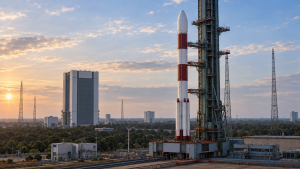
The first industry-built Polar Satellite Launch Vehicle (PSLV), PSLV-N1, is expected to launch in the first quarter of 2027. Indian Space Research Organisation (ISRO) Chairman V. Narayanan announced the timeline on 24 November 2026 at the India International Space Conclave in New Delhi.
Industry-led PSLV production
The Hindustan Aeronautics Limited–Larsen and Toubro consortium received a September 2022 contract from NewSpace India Limited (NSIL) to realise five PSLV-XL launch vehicles end to end. The arrangement moves the consortium beyond supplying components to manufacturing, assembling, integrating and delivering complete vehicles. PSLV-N1’s earlier targets included the first quarter of 2026 and a general 2026 launch. Delays have been linked to coordination with the EOS-10 earth-observation satellite, also called Oceansat-3A, launch-window availability and changes in component providers after two consecutive PSLV failures.
Other space programme updates
Narayanan said the Gaganyaan human spaceflight mission was in its final phase, with rocket items ready and work continuing on the orbital module. ISRO and a semiconductor laboratory in Chandigarh developed the Vikram processor; the Vikram 16 series is in use, while Vikram 32 chips are due for induction. He also cited 56 Indian space assets, 440 start-ups in the space sector and collaboration with 64 countries in space development.
Important Facts for Exams
- Alternating propulsion: The PSLV has four stages that alternate between solid- and liquid-propulsion systems.
- Multiple-orbit deployment: The PSLV’s fourth stage can reignite, enabling payloads to be deployed into multiple orbits during one launch campaign.
- CA and XL variants: The PSLV-CA flies without strap-on motors, whereas the PSLV-XL uses six extended strap-on motors, each carrying 12 tonnes of propellant.
| Related | |
|---|---|