Crop Diversification and Alternative Crops in India
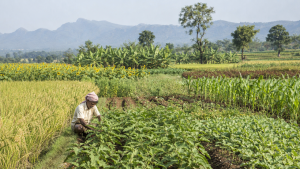
Crop diversification broadens the crops and farming systems grown by a household or region. It can reduce dependence on a narrow set of crops, support farm incomes and improve resilience to water scarcity, soil degradation and climate variability. Its success depends on suitable crop choices, reliable markets and effective risk management.
Meaning and Significance
Crop diversification includes introducing new crops, changing cropping patterns and adopting systems such as intercropping, mixed cropping and agroforestry. It may take place within a field or across a farm. The aim is not simply to increase the number of crops, but to match production to local resources, farmer needs and market opportunities. Reliance on monoculture can expose farmers to price fluctuations, crop failure and resource stress. Crop rotation and a wider mix of crops can help maintain soil health, while different crop choices may spread production and income risks across seasons. Diversification can also respond to changing consumer demand and contribute to nutritional security through a broader range of food crops. For sustainable agriculture, crop choices need to reflect regional conditions. A shift from water-intensive crops may be useful where water is scarce, while other regions may have different soil, rainfall or market constraints. Regional crop planning is therefore important: a single alternative crop or cropping pattern is not suitable everywhere.
Drivers of Diversification
Several economic, environmental and social pressures encourage farmers to consider alternative crops:
- Water scarcity: Dependence on water-intensive crops such as paddy and sugarcane can add pressure to groundwater in some regions. Less water-intensive crops may be better suited to areas facing limited water availability.
- Soil health: Repeated cultivation of the same crop can contribute to nutrient depletion and soil degradation. Crop rotation and a varied cropping pattern can support soil fertility.
- Income and markets: Price volatility in traditional crops can make farm income unstable. High-value crops may offer better returns, but profitability depends on market access and prices.
- Climate variability: Changes in rainfall and temperature increase the need to consider crops that can withstand local climatic conditions.
- Nutrition: A broader range of crops, including nutri-cereals and pulses, can support more diverse food production and diets.
Diversification can thus serve both as a sustainable-agriculture measure and as agricultural risk management. However, a crop that is resilient to drought or valuable in the market will not necessarily be a viable choice without suitable seed, technical knowledge and a means to sell the harvest.
Alternative Crops
Alternative crops vary in their water needs, uses and market prospects. Their suitability depends on local conditions and the capacity to produce and market them.
- Millets: Jowar, bajra, ragi, foxtail millet and kodo millet are drought-resistant nutri-cereals. India observed 2023 as the International Year of Millets.
- Pulses: Gram, tur, moong, urad and lentil provide important protein sources. As nitrogen-fixing crops, pulses can also contribute to soil fertility.
- Oilseeds: Groundnut, rapeseed-mustard, soybean, sunflower and sesame contribute to edible oil production and can provide farm income.
- Horticultural crops: Fruits, vegetables, flowers and spices can offer high value per unit area, shorter crop cycles and export potential.
- Industrial crops: Cotton, jute and sugarcane have specific industrial uses and contribute to agricultural income.
- Medicinal and aromatic plants: These crops can provide niche market opportunities, subject to demand and suitable cultivation conditions.
Government Support and Institutional Roles
Government initiatives support production, insurance, technology dissemination and horticulture. Their contribution to diversification depends on whether assistance and market opportunities extend to crops beyond established staples.
- National Food Security Mission (NFSM): Launched in 2007–08, it aims to increase production of rice, wheat, pulses, coarse cereals and nutri-cereals through area expansion and productivity enhancement.
- Pradhan Mantri Fasal Bima Yojana (PMFBY): Provides financial support for crop loss or damage arising from unforeseen events. Insurance can help manage the risks farmers face when changing crops.
- Mission for Integrated Development of Horticulture (MIDH): A centrally sponsored scheme for holistic growth of horticulture, including fruits, vegetables and other high-value crops.
- Agricultural Technology Management Agency (ATMA): Provides a mechanism for disseminating agricultural technology, including information relevant to diversified farming systems.
- Direct Benefit Transfer (DBT): Enables direct transfer of subsidies and incentives to support farmers adopting new practices and crops.
- Minimum Support Price (MSP): Support prices can influence crop choices. The Commission for Agricultural Costs and Prices (CACP) recommends crop support prices; the Cabinet Committee on Economic Affairs (CCEA) makes the final decision on MSPs.
- Eastern India Diversification Programme: Aims to promote crop diversification in eastern states and reduce reliance on paddy.
Challenges and Priorities
Strong procurement and assured MSP for wheat and paddy can make farmers hesitant to switch crops. For many alternatives, underdeveloped markets can limit the ability to sell produce profitably. Shortages of quality seeds, suitable farm machinery and extension services, along with gaps in technical knowledge, can also impede adoption. Small and fragmented landholdings may make large-scale diversification difficult. Addressing these constraints requires linking crop choices to regional water and soil conditions, improving access to relevant technology and strengthening market opportunities. Insurance can contribute to risk management, but it does not replace reliable buyers or suitable production support. Diversification is most effective when economic incentives and environmental priorities are considered together.
Key Prelims Takeaways
- Crop diversification: Includes new crops, changing cropping patterns, intercropping, mixed cropping and agroforestry.
- NFSM: Launched in 2007–08; covers rice, wheat, pulses, coarse cereals and nutri-cereals.
- PMFBY and MIDH: Address crop-loss insurance and horticulture development, respectively.
- MSP process: CACP recommends support prices; CCEA takes the final decision.
- Crop traits: Pulses fix nitrogen; millets are drought-resistant nutri-cereals.
- Wheat facts: Bread wheat is hexaploid, while durum wheat used mainly for pasta is tetraploid. Crown-root initiation, about 20–25 days after sowing, is a critical irrigation stage for irrigated wheat.
- Wheat awns: They use water more efficiently in photosynthesis than leaves and are more prevalent in varieties grown in hot, drought-prone regions.
Recent Context
Wheat acreage for 2026/27 is projected at 31.58 million hectares, about 6% below the 2025/26 record, following low monsoon rainfall in 2026. Some farmers are shifting to chickpeas and rapeseed. The 2027–28 wheat MSP is ₹2,610 per 100 kg, up ₹25 from the previous season.
| Related | |
|---|---|