United Nations Mechanisms for Children in Armed Conflict
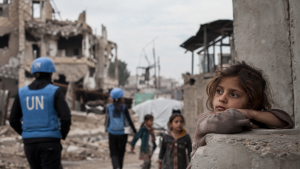
The United Nations’ framework for children affected by armed conflict combines advocacy, international legal protections and monitoring. It seeks to prevent grave violations, strengthen child protection and support accountability for parties responsible.
The Graça Machel Report and its Genesis
The 1996 United Nations report The Impact of Armed Conflict on Children, authored by Graça Machel, documented the effects of war on children and highlighted their status as primary victims of armed conflict. It helped bring the issue onto the international agenda and prompted the UN General Assembly to consider a dedicated mandate. General Assembly resolution 51/77, adopted in 1996, recommended creating a Special Representative for Children and Armed Conflict. The mandate gave the United Nations a dedicated platform to advocate for children affected by conflict and promote international action on their protection.
Special Representative for Children and Armed Conflict
The mandate of the Special Representative of the Secretary-General for Children and Armed Conflict (SRSG CAAC) was established by the General Assembly in December 1996. Its purpose is to strengthen protection, raise global awareness and foster cooperation to address the effects of armed conflict on children. The SRSG acts as an advocate and moral voice for children targeted by warfare, leading efforts to prevent and end grave violations. The office’s work includes diplomacy, advocacy and monitoring, and engagement with governments, regional organisations and civil society to promote child-protection standards.
- The SRSG reports directly to the UN Secretary-General.
- The office uses advocacy and diplomacy to encourage action to protect children and prevent violations.
- Vanessa Frazier of Malta was appointed Special Representative on October 3, 2025.
Optional Protocol on Children in Armed Conflict
The Optional Protocol to the Convention on the Rights of the Child on the involvement of children in armed conflict (OPAC) is a key international legal instrument. The General Assembly adopted it on May 25, 2000, through resolution A/RES/54/263. It entered into force on February 12, 2002. OPAC provides specific protections against children’s involvement in armed conflict. It prohibits the compulsory recruitment or use in hostilities of people under 18 by states and armed groups. States that permit voluntary recruitment into their national armed forces below the age of 18 must apply safeguards.
- Recruitment must be genuinely voluntary.
- Informed consent must be obtained from parents or legal guardians.
- States must maintain an accurate record of age and ensure that voluntarily recruited individuals under 18 are not directly involved in hostilities.
As of January 2023, 173 countries had ratified OPAC. The Protocol is one part of the broader protection framework: the SRSG mandate supports advocacy and cooperation, while the Protocol sets out specific legal protections concerning recruitment and participation.
Monitoring and Reporting Mechanism
The UN Security Council established the Monitoring and Reporting Mechanism (MRM) through resolution 1612 (2005). It is a country-specific system for monitoring, reporting and responding to six grave violations against children in armed conflict. Its purpose is to provide credible, objective and accurate information about these violations. Country Task Forces on Monitoring and Reporting (CTFMRs) gather information at country level. The resulting data informs the Secretary-General’s annual report on children and armed conflict. The Secretary-General’s report identifies parties responsible for grave violations; listed parties may appear in the report’s annexes, commonly known as the “list of shame”. The six grave violations monitored by the MRM are:
- Killing and maiming of children.
- Recruitment or use of children as soldiers.
- Sexual violence against children.
- Abduction of children.
- Attacks against schools or hospitals.
- Denial of humanitarian access for children.
Security Council Engagement
The Security Council has adopted resolutions that form a central part of the UN framework on children and armed conflict. Resolution 1612 (2005) established both the MRM and the Security Council Working Group on Children and Armed Conflict. The Working Group reviews the Secretary-General’s annual reports and makes recommendations to the Council on action in specific country situations. This connects monitoring findings with international engagement and possible responses.
- The Security Council may impose sanctions or refer situations to the International Criminal Court.
- It may also demand compliance with international law.
- Monitoring and reporting help draw attention to grave violations and support international accountability.
Key Prelims Takeaways
- The 1996 Graça Machel report was titled The Impact of Armed Conflict on Children.
- General Assembly resolution 51/77 (1996) recommended a dedicated mandate; the SRSG CAAC mandate was established in December 1996.
- Vanessa Frazier of Malta was appointed SRSG CAAC on October 3, 2025.
- OPAC was adopted on May 25, 2000, and entered into force on February 12, 2002.
- OPAC prohibits compulsory recruitment or use in hostilities of people under 18; 173 countries had ratified it by January 2023.
- Security Council resolution 1612 (2005) established the MRM and the Security Council Working Group on Children and Armed Conflict.
- The MRM monitors six grave violations, and its country-level information informs the Secretary-General’s annual report.
Recent Context
Graça Machel received the 2025 Indira Gandhi Prize for Peace, Disarmament and Development. The award recognised her work on human rights, education, and advocacy for women and children, including the contribution of her 1996 report to international child-protection efforts.
| Related | |
|---|---|