Asteroid 2026 QQ8 Becomes Earth’s Temporary Mini-Moon
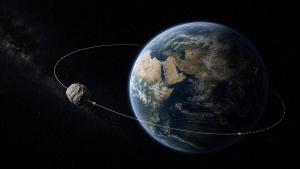
Asteroid 2026 QQ8 became a temporary mini-moon after entering Earth’s orbit in late April 2026. Hungarian astronomer Krisztián Sárneczky first spotted it on 20 August; the Minor Planet Center confirmed its natural origin as an asteroid on 29 October, after observations with the University of Hawaii 2.2-meter telescope and the Lowell Discovery Telescope.
Orbit and expected departure
Initially thought to be space debris, the object is estimated to be about 1 metre across, although some estimates put its diameter at 2 metres. It follows a kidney-shaped loop around Earth and comes within about 0.0038 astronomical units (AU), around 1.5 times the Earth–Moon distance. It is expected to remain gravitationally bound to Earth until December 2026, then escape and continue orbiting the Sun in 2027. It poses no threat; if it entered Earth’s atmosphere, its small size means it would burn up.
Future close approaches
Orbital data indicates that 2026 QQ8 makes close approaches to Earth roughly every 10 years, but also lists its previous close approach as 1965 and predicts the next in 2058. It was not captured during the earlier encounter and is not predicted to be captured in 2058.
Important Facts for Exams
- Orbit processing: The Minor Planet Center gathers minor-planet observations, calculates their orbits and publishes the results through Minor Planet Circulars.
- Observation follow-up: The Minor Planet Center helps observers coordinate follow-up of possible near-Earth objects through its NEO web form and confirmation page.
- Mini-moon distinction: Temporary-capture objects differ from quasi-satellites: the former become gravitationally bound to Earth, whereas quasi-satellites continue orbiting the Sun.
- Recapture dynamics: A later close approach does not guarantee recapture: temporary capture depends on encounter geometry and relative velocity, not proximity alone.
| Related | |
|---|---|