Types of Inhalers and Drug Delivery Devices
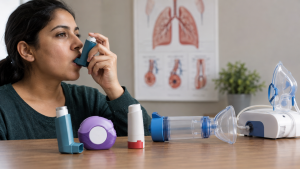
Inhalers and related delivery devices carry medicines to the respiratory tract, where they are used to manage conditions such as asthma and chronic obstructive pulmonary disease (COPD). Device design affects how a dose is released and the technique needed to deliver it effectively.
Metered Dose Inhalers
Metered dose inhalers (MDIs) are handheld, pressurised devices that release a measured quantity of medicine as an aerosol. The medicine is dissolved or suspended in a propellant, commonly a hydrofluoroalkane (HFA). After release, propellant droplets evaporate rapidly, leaving microscopic medicine particles for inhalation.
- Technique: The user generally needs to coordinate pressing the canister with a slow, deep inhalation. Poor coordination can reduce the amount reaching the lungs and increase deposition in the mouth and throat.
- Spacers: A spacer is a valved holding chamber attached to the mouthpiece. It acts as a reservoir, slowing aerosol entry into the mouth and reducing the need for precise coordination. This can help more medicine reach the lungs by limiting impaction in the oropharynx.
- Advantages and limitation: MDIs are portable and provide consistent measured doses. Their effectiveness depends partly on correct technique; a spacer can help address coordination difficulties.
Dry Powder Inhalers
Dry powder inhalers (DPIs) deliver medicine as a fine powder and do not use propellants. They are breath-actuated: the patient’s inspiratory effort draws and disperses the powder into the airways. The medicine may be combined with a carrier, such as lactose, to aid dispersion.
- Inhalation: The user needs to inhale quickly and deeply to draw the powder into the airways. Adequate inspiratory flow is therefore important for effective delivery.
- Single-dose devices: These require a medicine-filled capsule to be loaded into the inhaler for each dose.
- Multi-dose devices: These hold several doses, stored either in blisters or in a powder reservoir.
- Advantages and limitations: DPIs are propellant-free and do not require the user to synchronise a canister press with inhalation. However, delivery depends on the patient’s inspiratory effort, and powder may clump in humid conditions.
Nebulisers
Nebulisers convert liquid medicine into a fine mist, inhaled through a mask or mouthpiece over several minutes. They can be useful for people who have difficulty using handheld inhalers, including infants, young children, older people and those in severe respiratory distress. Treatment takes longer than with many handheld devices, but does not require the same coordination between actuation and inhalation.
- Jet nebulisers: A compressor forces air through the liquid medicine to create an aerosol.
- Ultrasonic nebulisers: High-frequency vibrations generate an aerosol from the liquid medicine.
- Mesh nebulisers: A vibrating mesh with tiny holes produces a fine mist; these devices can operate quietly and deliver medicine efficiently.
- Trade-offs: Nebulisers can be easier to use when coordination is limited and can deliver larger doses. They are generally less portable and require longer treatment times than inhalers.
Other Devices and Inhaled Medicines
Soft mist inhalers (SMIs) are propellant-free devices that produce a slow-moving, longer-lasting mist. Compared with the fast-moving aerosol from an MDI, this mist can be easier to inhale, reduce the need for precise coordination and improve medicine deposition in the lungs. Respimat is an example of an SMI. Nasal sprays deliver medicine mainly to the nasal passages rather than deep into the lungs. They are used for conditions such as allergic rhinitis and sinusitis and can also support systemic absorption through the nasal mucosa. The medicines used in inhalation devices have different therapeutic actions:
- Bronchodilators: These relax muscles around the airways, widening them and making breathing easier. Short-acting beta-agonists (SABAs), such as salbutamol (albuterol), provide quick relief from acute symptoms. Long-acting beta-agonists (LABAs), including salmeterol and formoterol, provide sustained bronchodilation for longer-term control.
- Inhaled corticosteroids: These reduce airway inflammation, swelling and mucus production. They are used to prevent asthma attacks and manage chronic inflammation in COPD. Examples include fluticasone propionate, budesonide and beclomethasone.
- Fluticasone action: Fluticasone propionate selectively activates glucocorticoid receptors, producing anti-inflammatory effects with negligible activity at several other steroid receptors.
- Combination inhalers: Some devices combine a LABA with an inhaled corticosteroid (ICS), providing bronchodilation and anti-inflammatory action in one inhaler.
Generic Medicines and ANDA Approval
The US Food and Drug Administration (USFDA) oversees approvals for drugs and medical devices, including generic medicines. Generic treatments can expand access to more affordable healthcare, while regulatory requirements support patient safety and comparable drug performance.
- ANDA: The Abbreviated New Drug Application pathway allows a generic manufacturer to seek approval by demonstrating bioequivalence to an approved reference listed drug.
- Bioequivalence: The generic must deliver the same amount of active ingredient at the same rate and extent of absorption as the reference drug.
- Evidence requirements: Generic applicants generally establish bioequivalence rather than submitting new preclinical studies and extensive human clinical-trial data to re-establish safety and effectiveness.
Key Prelims Takeaways
- MDIs: Use a propellant, commonly an HFA, to release a measured aerosol dose.
- Spacers: Hold and slow the aerosol, helping reduce mouth and throat deposition.
- DPIs: Are propellant-free and depend on the patient’s inspiratory effort.
- Nebulisers: Convert liquid medicine into an inhalable mist; types include jet, ultrasonic and mesh.
- SMIs: Produce a slow-moving mist without a propellant.
- Medicines: SABAs and LABAs are bronchodilators; ICS medicines reduce airway inflammation.
- ANDA: The generic-drug application pathway relies on demonstrating bioequivalence to a reference listed drug.
Recent Context
On November 25, 2026, the USFDA approved Cipla–Teva’s fluticasone HFA MDI in 110 mcg and 220 mcg strengths for asthma. It is the first generic equivalent to Flovent HFA for maintenance treatment in patients aged four years and older. Teva holds the ANDA; Cipla manufactures and supplies the inhaler.
| Related | |
|---|---|