Major Applications of Underwater Robotics in Maritime Operations
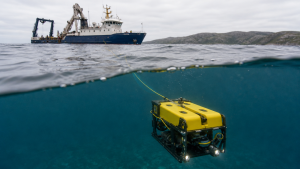
Underwater robotics uses uncrewed systems to explore, inspect and carry out tasks below the ocean’s surface. These vehicles support naval, industrial and scientific operations in deep, hazardous or difficult-to-access environments, reducing the need to place personnel underwater.
Types of Underwater Robotic Systems
Uncrewed Underwater Vehicle (UUV) is the broad term for an uncrewed system operating underwater. Its two main categories are Remotely Operated Vehicles (ROVs) and Autonomous Underwater Vehicles (AUVs).
- Remotely Operated Vehicles: An ROV is controlled by an operator, usually from a surface vessel or shore-based control station. A tether, or umbilical cable, links the vehicle to the station and can carry control signals and data, as well as supply power. The operator can receive visual or instrument-based information and direct the vehicle in real time. ROVs may carry cameras, lights, sensors and manipulator arms for observation and underwater tasks.
- Autonomous Underwater Vehicles: An AUV operates without continuous direct control through a tether. It follows a pre-programmed mission, collects data and stores it onboard for retrieval later. AUVs are suited to surveying large areas and can be used for seabed mapping, water sampling and environmental monitoring.
- Hybrid systems: Some underwater vehicles combine features of ROVs and AUVs. The choice of system depends on whether a task requires direct operator control and intervention or autonomous data collection over a wider area.
Applications in Maritime Operations
Underwater robots support defence, commercial and scientific work by providing access to subsea locations where human divers may face significant risks or operational constraints.
- Naval and maritime security: ROVs can inspect ports, harbours and underwater infrastructure, supporting port security and wider maritime security operations. Cameras and sensors allow operators to examine underwater locations without entering them directly.
- Surveillance and reconnaissance: Naval forces can use ROVs and AUVs to gather visual and sensor information for intelligence, surveillance and reconnaissance. ROVs allow real-time operator direction, while AUVs can conduct planned missions without continuous tethered control.
- Mine countermeasures: Underwater robotic systems can support the detection and classification of naval mines and improvised explosive devices. Their use can help keep personnel away from hazardous underwater objects; neutralisation tasks depend on the vehicle’s capabilities and mission requirements.
- Search and recovery: ROVs can help locate and recover objects from underwater sites, including sunken vessels, aircraft and black boxes, and can support the recovery of missing persons. Their cameras and sensors provide information from locations that may be difficult or unsafe for divers to reach.
- Offshore industry: The oil and gas sector uses underwater robots to inspect, maintain and repair subsea infrastructure such as pipelines and platforms. They can also support drilling operations and the laying and inspection of subsea cables.
- Offshore wind infrastructure: Robots can help assess offshore wind farms and inspect underwater components. Using remotely operated systems in deep or hazardous conditions can reduce risks to divers and support more efficient inspection work.
- Scientific research and environmental monitoring: AUVs and ROVs assist with deep-sea exploration, bathymetry and the study of marine ecosystems. They can collect information on water quality, temperature, salinity and pressure, and support monitoring of ocean pollution and coral reef health.
Operational Features and Technologies
The equipment carried by an underwater robot depends on its task. Common payloads include high-resolution digital cameras, black-and-white and colour television cameras, sonar systems such as CTFM sonar and multibeam echo sounders, and environmental sensors. Thermal imaging and LiDAR are also listed among the technologies used in these systems. ROVs may carry manipulator arms to collect biological or geological samples, undertake repairs or handle explosive ordnance. These capabilities allow a vehicle to move beyond observation to physical intervention, subject to its design and the task assigned. Operational performance depends on manoeuvrability, navigation, endurance and the ability to work in challenging conditions such as strong underwater currents and poor visibility. Depth capability varies by system: some ROVs can reach 20,000 feet, while the EyeROV TROUT has a stated maximum operating depth of 300 metres. TROUT’s operational features include operator control, navigation, endurance and the ability to operate in currents and poor visibility.
Indigenous Development and Quality Assurance
Indigenous underwater robotics is linked to efforts to strengthen self-reliance in defence technology. The Innovations for Defence Excellence (iDEX) initiative was launched by the Ministry of Defence in 2018 to support the development of defence and aerospace technologies by innovators and enterprises. The Indian Navy’s SPRINT initiative, launched in July 2022, promotes indigenous development of technologies for naval use. The EyeROV TROUT was developed under the iDEX Defence India Startup Challenge (DISC) 7 SPRINT Challenge. Its field trials and system-level validation assessed manoeuvrability, deep-diving capability, performance in currents, detection, navigation, endurance and operator control. Quality assurance for naval equipment is undertaken by the Directorate of Quality Assurance (Naval) (DQA(N)), part of the Directorate General of Quality Assurance (DGQA) under the Department of Defence Production, Ministry of Defence. DQA(N) processed the TROUT under its quality assurance framework. The system was engineered to meet applicable military standards, including Environmental Stress Screening (ESS), which checks whether equipment can withstand environmental stresses associated with its intended operating conditions.
Key Prelims Takeaways
- UUV: Broad term for uncrewed systems that operate underwater.
- ROV: Operator-controlled vehicle, typically linked to a control station by a tether; it can carry cameras, sensors and manipulator arms.
- AUV: Untethered vehicle that follows a planned mission without continuous direct control and stores data onboard.
- iDEX and SPRINT: iDEX is a Ministry of Defence initiative launched in 2018; SPRINT is an Indian Navy initiative launched in July 2022.
- DQA(N) and ESS: DQA(N) handles naval equipment quality assurance; ESS assesses resistance to environmental stresses.
- TROUT: EyeROV ROV with a stated maximum operating depth of 300 metres, developed under the iDEX DISC 7 SPRINT Challenge.
Recent Context
On October 7, 2026, EyeROV delivered two TROUT ROV systems to the Indian Navy. The delivery is the first of five systems ordered and marks the introduction of India’s first indigenously built military-grade ROV.
| Related | |
|---|---|