Types of Uncrewed Underwater Vehicles and Their Applications
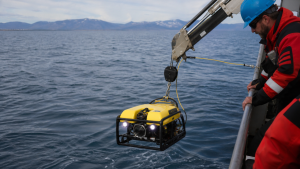
Uncrewed Underwater Vehicles (UUVs) are robotic systems that operate underwater without a person onboard. The two principal types are remotely operated vehicles (ROVs), controlled by an operator, and autonomous underwater vehicles (AUVs), which navigate without continuous direct control.
Overview of Uncrewed Underwater Vehicles
UUVs support work in underwater environments that may be hazardous, difficult to access or unsuitable for continuous human presence. Their size and capabilities vary, and mission equipment can include cameras, lights, sonar and other sensors. Some vehicles also carry manipulator arms for physical tasks. UUVs are used in scientific, commercial and naval operations. They can help inspect underwater infrastructure, collect information from the seabed and support maritime security. The choice of vehicle depends on the task: ROVs are suited to operator-directed observation and intervention, while AUVs can cover areas without a continuous tether to a surface station.
Remotely Operated Vehicles
An ROV is an uncrewed underwater vehicle controlled by an operator, typically from a vessel or shore station through a tether, also called an umbilical cable. The tether carries control signals and data and can provide power. This link allows operators to view information from underwater cameras and sensors and adjust the vehicle’s actions in response to conditions. ROVs use thrusters to move and may carry lights, cameras, sonar and manipulator arms. These systems can support visual inspection as well as tasks that require tools or direct handling. Operator control is particularly useful when a mission involves close examination, changing conditions or a specific intervention.
- Infrastructure inspection: Examine underwater pipelines, cables and other subsea installations.
- Security: Support port and harbour security and broader maritime surveillance.
- Search and recovery: Locate and help recover objects from underwater sites.
- Intervention: Carry out robotic tasks, including work at subsea installations.
Autonomous Underwater Vehicles
An AUV navigates underwater without continuous direct control through a tether. It can follow a pre-programmed mission using onboard sensors and navigation systems, giving it greater freedom of movement than a tethered vehicle. Its operating endurance is constrained by its available energy. AUVs are suited to missions that require repeated data collection or coverage of broad areas. They generally store collected information onboard for retrieval after the mission; some can transmit data acoustically in bursts or communicate when they surface. This differs from the continuous operator feedback available with a tethered ROV.
- Mapping and surveys: Collect data for seabed mapping, charting and hydrographic surveys.
- Environmental research: Monitor conditions such as ocean currents and water quality.
- Naval operations: Support mine countermeasures and anti-submarine warfare-related tasks.
- Infrastructure planning: Survey pipeline routes and monitor subsea infrastructure.
How ROVs and AUVs Differ
The principal distinction is the degree and means of operator control. An ROV remains linked to its operator by a tether, enabling real-time observation and adjustments. An AUV operates without a continuous tether and follows its programmed mission using onboard systems. These differences affect data access, endurance, mobility and the kinds of tasks each vehicle can perform.
- Control: ROVs are remotely controlled; AUVs navigate autonomously along planned missions.
- Connection: ROVs use a tether for control and data, and typically power; AUVs operate untethered.
- Feedback: ROVs provide operators with live visual or instrument-based information; AUV data is generally stored for retrieval or transmitted intermittently.
- Mission fit: ROVs are useful for detailed inspection and intervention; AUVs are suited to broad-area or repetitive data collection.
Both types can operate at significant depths, but tether management is a consideration for ROV missions. AUVs avoid this constraint but are limited by onboard energy and the need to complete tasks within their programmed parameters. Selection therefore depends on mission requirements, operating conditions and whether real-time operator input or untethered coverage is more important.
Indigenous Development and Quality Assurance
Indigenous development of UUVs contributes to defence technology and maritime security, while supporting the inspection and protection of underwater infrastructure. In India, Innovations for Defence Excellence (iDEX), a Ministry of Defence initiative, supports innovators and enterprises developing defence and aerospace technologies. The Indian Navy’s SPRINT initiative promotes indigenous development of technologies for naval use. The EyeROV TROUT was developed under the iDEX DISC 7 SPRINT Challenge. Its field trials and system-level validation covered manoeuvrability, deep-diving capability, performance in currents, detection, navigation, endurance and operator control. The system is designed for underwater inspection, surveillance, reconnaissance, search and recovery, detection and robotic intervention. Its stated features include operation in strong underwater currents and poor visibility. Quality assurance is also part of the development process. The TROUT was processed through the Directorate of Quality Assurance (Naval), or DQA(N), framework and engineered to meet applicable military standards. This included Environmental Stress Screening (ESS), which checks whether equipment can withstand environmental stresses associated with its intended operating conditions.
Key Prelims Takeaways
- UUVs are broadly classified as remotely operated vehicles (ROVs) and autonomous underwater vehicles (AUVs).
- ROVs are typically tethered and operator-controlled; AUVs can navigate without continuous direct control through a tether.
- ROV payloads may include cameras, lights, sensors and manipulator arms.
- iDEX is a Ministry of Defence initiative; SPRINT is the Indian Navy’s initiative to promote indigenous naval technology.
- DQA(N) provides the quality assurance framework; ESS checks resilience to environmental stresses.
- EyeROV secured a ₹47 crore Indian Navy contract to supply advanced underwater ROVs.
Recent Context
On October 7, 2026, EyeROV delivered two TROUT ROV systems to the Indian Navy, the first of five systems ordered. The delivery marks India’s first indigenously built military-grade ROV. The TROUT is rated to operate at depths of up to 300 metres.
| Related | |
|---|---|