LiDAR Survey to Map Hidden Monuments at Lakkundi
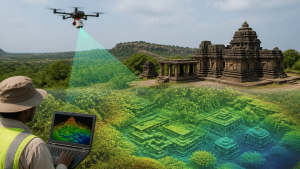
Lakkundi in Gadag district of Karnataka is the site of a six-month LiDAR survey and geospatial mapping project under a Memorandum of Understanding between the Department of Archaeology, Museums and Heritage, Karnataka, and the National Institute of Advanced Studies, Bengaluru. The project uses non-invasive digital tools to locate buried structures linked to the Kalyana-Chalukya era, which dates to the 10th to 12th centuries CE.
LiDAR and Geospatial Survey Methods
Light Detection and Ranging, or LiDAR, is a remote-sensing technique that uses laser pulses to measure distances and create high-resolution terrain models. Geographic Information System mapping, remote sensing, and Ground Penetrating Radar are used in archaeology to identify subsurface features, buried walls, and landscape patterns without excavation.
Archaeological Background of Lakkundi
Lakkundi is known for temple architecture, stepwells, and inscriptions associated with the Western Chalukya or Kalyana-Chalukya period. Local tradition refers to “101 wells and 101 temples”, and the survey aims to verify this folklore through scientific mapping and field documentation.
Excavations and Heritage Documentation
Since 2023, authorities have identified 70 monuments in Lakkundi, including 32 temples, 28 wells, and seven other structures. Archaeological excavations at the site recovered more than 1,500 artefacts in Phase 1 and more than 1,800 artefacts in Phase 2, which began on 2 May 2026.
Protection and Museum Plans
The Karnataka government has planned state protection for 44 heritage sites in Lakkundi. A three-acre open-air museum has also been proposed to document and display more than 5,000 expected artefacts, with a target completion date of 30 June 2026.
Important Facts for Exams
- LiDAR is a laser-based remote-sensing method used for topographic and archaeological mapping.
- Ground Penetrating Radar is used to detect buried objects and subsurface layers.
- The Kalyana-Chalukya period belongs to the 10th to 12th centuries CE in Karnataka.
- The Archaeological Survey of India is India’s central agency for archaeological research and monument protection.
Excavations at the Kote Veerabhadreshwar Temple in Lakkundi yielded Neolithic-era artefacts, including a stone axe and grey clay pots. These finds extend the known history of Lakkundi beyond the medieval period.
| Related | |
|---|---|