Wild Mushrooms: Edibility, Toxicity and Food Safety
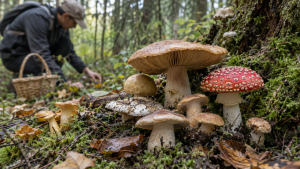
Mushrooms are the fruiting bodies of fungi, a diverse group that includes both valued foods and species capable of causing severe poisoning. Wild collection is difficult to do safely: appearance alone is not a reliable guide, and some toxic species resemble edible ones.
Mushroom Biology and Ecological Roles
Fungi are eukaryotic organisms distinct from plants and animals; their cell walls contain chitin. A mushroom is the fruiting body of some macroscopic fungi, while much of the organism grows in the material from which it obtains nutrients. Many wild mushrooms are saprobic, breaking down dead wood and plant matter and returning nutrients to the environment. Others form symbiotic associations, including mycorrhizae with plant roots, or live as parasites. Fungi reproduce by spores, which may be dispersed by wind, water or animals. Stinkhorns use a distinctive method: insects are attracted to the gleba, the spore-bearing mass, and may spread intact spores after consuming it and depositing them in their excrement. Phallus indusiatus, also known as the veiled lady or bamboo pith, belongs to the family Phallaceae in the order Phallales. It is a stinkhorn, not a gilled mushroom. It is saprobic and obtains nutrients from decomposing wood and plant organic matter, including dead bamboo.
Edible Wild Mushrooms
Only a small fraction of known wild mushroom species are considered safe to eat. Edible species may be associated with particular habitats and seasons, but habitat or appearance alone does not establish that a specimen is safe. Identification can involve examining cap shape, gill attachment, stem, ring (annulus), cup-like volva at the base, spore-print colour and odour. These features must be considered together. Examples of wild mushrooms commonly collected for food include:
- Morels (Morchella species): Recognised by honeycomb-like caps and hollow stems; they may occur in forests, including after fires or on disturbed ground.
- Chanterelles (Cantharellus species): Often trumpet-shaped, with wavy cap margins, blunt ridges that may fork rather than true gills, and a fruity aroma.
- Oyster mushrooms (Pleurotus ostreatus): Fan-shaped, with gills running down a short, off-centre stalk; they often grow in clusters or shelves on decaying wood.
- Lion’s mane (Hericium erinaceus): Has cascading white spines and grows on hardwood trees.
Phallus indusiatus is cultivated as an edible mushroom in parts of Asia. Commercial cultivation does not establish that a wild specimen is safe to collect or eat; the risks of amateur collection remain distinct from those of controlled production.
Toxic Mushrooms and Poisoning
Mycetism is illness caused by ingesting poisonous fungi. Effects depend on the species, amount consumed and individual sensitivity. Symptoms can range from nausea, vomiting and diarrhoea to hallucinations, seizures, and damage to the liver, kidneys or heart. Some symptoms are delayed, which can make identification and treatment more difficult. Important toxic genera and compounds include:
- Amanita species: The Death Cap (Amanita phalloides) and Destroying Angel (Amanita virosa) contain amatoxins, potent liver-damaging cyclic peptides. Symptoms may begin 6–24 hours after ingestion, with gastrointestinal illness, an apparent period of recovery, and then severe liver or kidney failure.
- Galerina species: Galerina marginata also contains amatoxins and may be mistaken for edible mushrooms.
- Cortinarius species: Some contain orellanine, a kidney toxin; symptoms may take days or weeks to appear.
- Gyromitra esculenta (false morel): Contains gyromitrin, which is metabolised to monomethylhydrazine and can affect the central nervous system, liver and gastrointestinal tract. It can be fatal if inadequately prepared or eaten in large quantities.
- Psilocybe species: Psilocybin and psilocin can alter perception and mood and may cause psychological distress.
- Chlorophyllum molybdites (the Vomiter): A common lawn mushroom that can cause severe gastrointestinal upset.
Food Safety and Public Health
There is no simple test or universal rule that reliably separates edible mushrooms from poisonous ones. Toxic species may resemble edible varieties, and identification can be difficult even for experienced foragers. Public health awareness should emphasise this risk, while food safety regulation can support safe handling and consumption. Indigenous knowledge may inform understanding of local species and practices, but it should not replace reliable identification of a particular specimen.
- Seek expert identification: Do not eat a wild mushroom unless it has been positively identified by an expert. Identification may require examining specimens at different stages of growth.
- Learn dangerous species: Familiarity with poisonous mushrooms can help reduce the risk of confusing them with edible look-alikes.
- Do not rely on appearance alone: White gills, a ring on the stem or a volva can occur in dangerous species, but these features are not a complete identification test.
- Cook thoroughly: Some edible mushrooms may cause mild gastric upset when eaten raw.
- Start with a small quantity: Individual sensitivity to even correctly identified edible species can vary.
- Do not use animal consumption as a test: A mushroom eaten by an animal may still be toxic to humans.
- Keep a specimen if poisoning is suspected: Retain a sample of the raw mushroom for medical professionals to help identify it.
The practical rule is: “When in doubt, throw it out.” Cultivation or local familiarity with a species does not make an unidentified wild specimen safe.
Key Prelims Takeaways
- Mushrooms are fungal fruiting bodies; fungi have chitin-containing cell walls.
- Wild fungi may be saprobic, symbiotic or parasitic.
- Phallus indusiatus is a saprobic stinkhorn in Phallaceae, order Phallales, and is not gilled.
- Stinkhorn spores can be dispersed when insects consume the gleba and later deposit intact spores.
- Amatoxins in Amanita phalloides can cause delayed, severe liver injury.
- There is no simple test for edible mushrooms; expert identification is essential.
Recent Context
Biologist and nature education officer S. Gagana observed Phallus indusiatus at Ranganathittu Bird Sanctuary on November 17, 2026; the sighting was reported on November 20. C. Hemavathi confirmed the identification. The fungus has a dark cap, white stalk and lace-like indusium; wild mushrooms should not be eaten without expert identification.
| Related | |
|---|---|