Scientists Link Solar Magnetic Fields to Polar Brightening
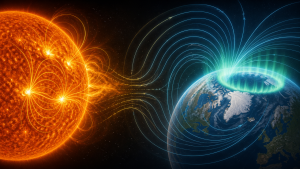
Research reported on 12–13 October 2026 examined how the Sun’s polar magnetic environment relates to microwave polar brightening. The collaborative study involved the Aryabhatta Research Institute of Observational Sciences (ARIES), Udaipur Solar Observatory (USO) of the Physical Research Laboratory, IIT Delhi and IIT Roorkee.
Observations and Instruments
The researchers analysed nearly three decades of solar observations at 17 GHz from Japan’s Nobeyama Radioheliograph. They compared these radio observations with extreme-ultraviolet data from NASA’s Solar Dynamics Observatory and magnetic-field measurements from the Wilcox Solar Observatory in California.
Microwave polar brightening refers to enhanced radio emission observed in the Sun’s polar regions. The study found that its intensity was strongly related to the size of polar coronal holes, and even more closely related to the strength of the Sun’s polar magnetic field. The research was led by Rohan Bose of ARIES and IIT Roorkee, with Anshu Kumari of USO/PRL and Vaibhav Pant of IIT Delhi.
Coronal Holes and Bright Points
Coronal holes are regions of the solar corona with relatively low density and temperature. Their magnetic field lines extend outwards into interplanetary space, and these regions appear dark in extreme-ultraviolet and X-ray images. Coronal holes are sources of high-speed solar wind.
The study found that individual microwave-bright patches often coincided with coronal bright points. These compact, bright features are associated with small-scale magnetic loops and are commonly found within polar coronal holes. The findings connect the observed radio emission with both large-scale polar magnetic fields and smaller magnetic structures.
Solar Magnetic Activity and Findings
The long-term evolution of microwave polar brightening and the area of polar coronal holes differed between the northern and southern solar hemispheres. The study linked changes in microwave brightening to variations in the Sun’s polar magnetic field and to the evolving magnetic structure of the polar atmosphere.
The findings were published in The Astrophysical Journal, a peer-reviewed astronomy and astrophysics journal published by the American Astronomical Society. The study combined radio, extreme-ultraviolet and magnetic-field observations to examine solar polar activity across multiple decades.
Important Facts for Exams
- The Nobeyama Radioheliograph is a solar radio observatory in Japan that observes the Sun at 17 GHz.
- NASA’s Solar Dynamics Observatory was launched in 2010 to study the Sun.
- Coronal bright points are small-scale bright features associated with magnetic loops in the solar atmosphere.
- The Wilcox Solar Observatory is located in California and measures the Sun’s magnetic field.
Solar microwave emissions are radio observations, while extreme-ultraviolet observations trace hot plasma in the solar atmosphere. The study’s results appeared in The Astrophysical Journal.
| Related | |
|---|---|