Saffron Flowers Bloom in Leh Within 30 Days
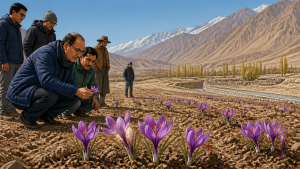
Experimental saffron cultivation at Spituk Pharka in Leh, Ladakh, produced its first flowers within 30 days of planting, compared with the usual period of about two months. On 1 November 2026, Lieutenant Governor Vinai Kumar Saxena said the field had averaged 20–25 flowers a day, with 72 recorded on the morning of 31 October. About 22 grams of saffron had been collected during the first four days of flowering.
Project Him Sarovar’s saffron pilot
Nearly 90,000 premium Iranian saffron corms, weighing about 800 kilograms, were planted on 1 October across roughly 4,000 square metres of previously barren land. The pilot is part of Project Him Sarovar, which aims to restore degraded land and put it to productive use. Water from the restored Igoo-Phey irrigation canal is being channelled to the site to improve soil moisture.
The administration is assessing whether saffron is suited to Ladakh’s agro-climatic conditions and whether cultivation is economically viable. The project could support commercial farming and local livelihoods. Jammu and Kashmir accounts for nearly 90 per cent of India’s saffron production.
Important Facts for Exams
- Corm propagation: Saffron crocus produces no viable seeds, so growers propagate it by digging up, dividing and replanting its corms.
- Climate and flowering: Saffron favours dry summers and spring rain; rain just before flowering can boost yields, while cold or wet flowering conditions promote disease and reduce them.
- ISO quality testing: ISO 3632 assesses saffron through laboratory measurements of crocin for colour, picrocrocin for taste and safranal for aroma.
| Related | |
|---|---|