Kuno Cheetah CCB-4 Enters Rajasthan’s Baran Forest Area
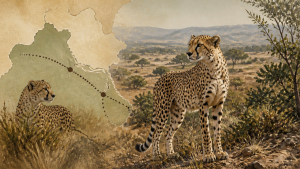
Male cheetah CCB-4 travelled from Madhya Pradesh’s Kuno National Park into the forests of Baran district, Rajasthan, on Friday night. By 1 November 2026, he was in the Anjaronda forest area of the Kelwara range, Deputy Conservator of Forests Vivekanand Manikrao confirmed.
Route and monitoring
CCB-4 covered about 16 kilometres, crossing from Kurkuta village in Madhya Pradesh to Kurkuti in Rajasthan and moving through Dua, Silori and Khushiara before reaching Anjaronda. Wildlife teams from Kuno National Park and the Kelwara forest range are jointly tracking his movements in real time.
Background and habitat
About two-and-a-half to three years old, CCB-4 arrived from Botswana on 28 February 2026 as part of the third batch under Project Cheetah. In September, he formed an unusual hunting alliance with KNG-23, an India-born male; male cheetah coalitions typically consist of brothers.
Baran’s open, semi-arid scrub and grasslands provide less-dense vegetation and prey such as chital, chinkara and young nilgai. Cheetahs KP-2 and KP-3, and female Veera with cub KPV-2, have also spent extended periods in the region; Veera and her cub returned to Kuno in late September 2026.
Important Facts for Exams
- Range patterns: Female cheetahs are generally nomadic across large home ranges, whereas males are more sedentary and hold smaller territories with prey and access to females.
- Spot-based identification: Each cheetah has a distinctive coat-spot pattern that can be used to identify the individual.
- Hunting sequence: A cheetah stalks to within 30–200 metres, then charges, trips its prey with a dewclaw and kills it with a throat bite.
| Related | |
|---|---|