Parliamentary Panel Backs National Pine Needle Policy
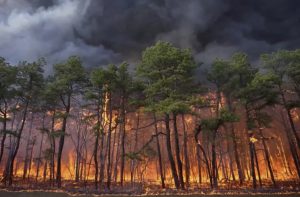
The Parliamentary Standing Committee on Science and Technology, Environment, Forests and Climate Change presented its 412th report on forest fires in the Himalayan region in August 2026. The report covered forest-fire causes, mitigation measures, pine-needle management, biomass use, satellite support, and disaster-response capacity in the Western Himalayas.
Forest Fires in the Himalayan Region
Forest fires are uncontrolled fires in forests, scrublands, or grasslands, and they are classified as surface fires, crown fires, and ground fires. In the Himalayan region, dry pine needles, steep slopes, and seasonal dryness are among the physical factors linked with fire spread. Chir Pine forests account for about 57% of forest fire incidents in the Western Himalayas. Pine needles are also called pirul in several Himalayan areas, and they accumulate on forest floors as dry biomass.
National Pine-Needle Utilisation Policy
The committee recommended that the Ministry of Environment, Forest and Climate Change frame a National Pine-Needle Utilisation Policy with State Governments. The proposal includes identification of fire-prone zones and fiscal incentives for dry biomass collection. The panel also proposed a prevention-led Himalayan Biomass Management Framework and a Himalayan Pirul Management Mission. It suggested a minimum procurement rate of ₹3–4 per kg for pine needle collection.
Management, Energy Use and Disaster Response
The committee advised the creation of a National or Regional Pine Needle Management Board for oversight of clearing and utilisation. It also recommended the use of processed pine-needle pellets, which have an energy value of about 5,500 kcal/kg, for co-firing in thermal power stations. The report urged the Department of Space to prioritise a dedicated geostationary satellite for forest-fire monitoring. It also recommended at least two regional National Disaster Response Force centres for forest-fire response in the Himalayan region.
Important Facts for Exams
- Chir Pine is a Himalayan conifer species associated with dry needle litter and recurring forest-fire risk.
- Co-firing is the use of biomass or other fuels together with coal in thermal power stations.
- The National Disaster Response Force was constituted under the Disaster Management Act, 2005.
- The Forest Research Institute is located in Dehradun and functions under the Indian Council of Forestry Research and Education.
Ecological Study and Policy Context
The committee asked the Forest Research Institute to conduct a region-specific historical-ecological study in the Western Himalayas. Such studies examine vegetation patterns, land use, and long-term ecological change in a defined region.
| Related | |
|---|---|