Oxygen Collisions Recreate Primordial Matter at RHIC
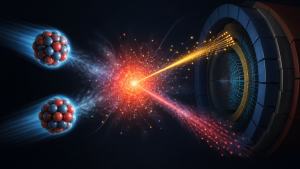
On 30 October 2026, scientists with the STAR experiment at the Relativistic Heavy Ion Collider (RHIC), at Brookhaven National Laboratory in Upton, New York, announced evidence of quark-gluon plasma (QGP) production in oxygen-nucleus collisions. QGP is a hot, dense state of matter that existed shortly after the Big Bang.
Evidence from oxygen collisions
The analysis used oxygen–oxygen collision data recorded at RHIC in 2021 at 200 billion electron volts (GeV). Researchers observed about 20% suppression of high-energy particles, attributed to jet quenching: energetic particle jets lose energy while travelling through dense matter. The findings were published in Physical Review Letters.
The measurement establishes a lower-energy boundary for producing QGP in this small collision system. Earlier evidence came from heavier-nucleus collisions or oxygen collisions at the Large Hadron Collider (LHC), where collision energies exceed 5,000 GeV. Li Yi of Shandong University oversaw the analysis; STAR physicist Rongrong Ma discussed the value of studying smaller collisions.
RHIC and its final run
RHIC, a US Department of Energy Office of Science User Facility at Brookhaven National Laboratory, operated from 2000 until its final run. Its STAR and sPHENIX detectors recorded oxygen–oxygen collisions on 6 February 2026.
Important Facts for Exams
- Deconfinement: In quark–gluon plasma, quarks are deconfined, unlike in ordinary matter where they remain confined.
- Energy-loss mechanism: Partons lose energy through collisions and medium-induced gluon radiation as they traverse the plasma; radiation is the dominant mechanism.
- What experiments detect: Jets begin as partons, which quickly combine into hadrons; experiments directly observe the resulting hadrons, not the original partons.
| Related | |
|---|---|