IceCube Detects Ultra-High-Energy Cosmic Neutrinos
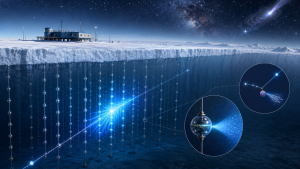
On 2 November 2026, scientists reported detecting cosmic neutrinos with energies about 10 billion times higher than typical solar neutrinos using the IceCube Neutrino Observatory in Antarctica.
Detecting rare cosmic particles
Embedded in about one cubic kilometre of Antarctic ice, IceCube records brief blue flashes of Cherenkov radiation. These occur when a neutrino interacts with the ice and produces a charged particle. The observatory detects only a few dozen of the most energetic neutrinos each year.
Neutrinos interact weakly with matter, allowing them to travel vast distances and escape regions around collapsing stars and black holes. They can carry information that other forms of radiation cannot, and may help scientists investigate the Big Bang and extreme cosmic events. George Fuller, a physicist at the University of California San Diego, said the origins and acceleration processes of these high-energy neutrinos remain poorly understood.
Recognition for IceCube research
Physicist Francis Halzen received the 2026 Nobel Prize in Physics for decisive contributions to IceCube and the discovery of high-energy neutrinos of astrophysical origin.
Important Facts for Exams
- Optical-module deployment: IceCube’s digital optical modules are arranged in strings of 60, installed 1,450–2,450 metres deep in holes melted with a hot-water drill.
- Flavour identification: IceCube can infer neutrino flavour in charged-current events because the resulting electron, muon and tau signatures differ.
- DeepCore energy reach: IceCube’s densely instrumented Deep Core region extends the array’s observable energies below 100 GeV.
- Northern-sky sensitivity: IceCube can observe neutrinos from any direction, but cosmic-ray muon background makes southern-hemisphere point sources harder to detect than northern ones.
| Related | |
|---|---|