Hera Reveals DART’s Impact on Dimorphos
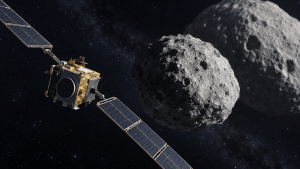
On 25 November 2026, the European Space Agency (ESA) announced that its Hera mission had reached the Didymos-Dimorphos binary asteroid system. Initial images show substantial changes to Dimorphos, the 151-metre moonlet struck by NASA’s DART spacecraft in 2022.
Changes after the DART impact
Images show one face of Dimorphos flattened, with a stadium-sized crater extending across its width. The impact also left the moonlet tumbling chaotically, rather than rotating synchronously, and hundreds of previously unknown boulders now encircle the system. The larger, 730-metre Didymos appears unchanged, retaining its boulder fields and central equatorial ridge. DART struck Dimorphos at 6.1 kilometres per second on 26 September 2022, reducing its orbital period around Didymos by 33 minutes—from 11.92 to 11.37 hours. Hera principal investigator Patrick Michel and planetary scientist Sabina Raducan expressed astonishment at the observed changes.
Hera’s next observations
Launched in October 2024, Hera is ESA’s first planetary defence mission and is studying the effects of the kinetic impact test. It will continue observations until June 2027, approaching closer for higher-resolution images. In January 2027, it is scheduled to deploy two shoebox-sized CubeSats, Milani and Juventas, to investigate the asteroids’ interior and surface composition.
Important Facts for Exams
- Impact efficiency: Hera’s impact assessment uses crater dimensions and transferred momentum to estimate how efficiently an artificial impact deflects an asteroid.
- Juventas radar: Juventas carries JuRa, a 50–70 MHz radar with 10–15-metre resolution, designed to probe an asteroid’s inner layers.
- Milani spectral range: Milani’s ASPECT hyperspectral spectrometer operates across visible and near-infrared wavelengths from 0.65 to 2.50 microns.
| Related | |
|---|---|