GRAP Stage III Curbs Imposed Across Delhi-NCR
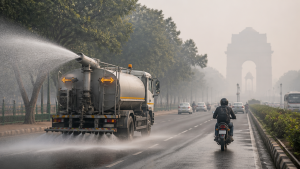
The Commission for Air Quality Management (CAQM) imposed Stage III of the Graded Response Action Plan (GRAP) across Delhi and the National Capital Region (NCR) on 6 November 2026, ahead of Diwali. The measure was taken as a precaution as pollution worsened. At 9 a.m., the Central Pollution Control Board (CPCB) recorded Delhi’s Air Quality Index (AQI) at 391, in the ‘very poor’ category; 30 of 59 monitoring stations reported ‘severe’ air quality. Another reported city average was 382.
Vehicles and dust-generating activity
Stage III bars BS-III petrol and BS-IV diesel light motor vehicles (four-wheelers) in Delhi and the NCR districts of Gurugram, Faridabad, Sonipat, Ghaziabad and Gautam Buddh Nagar. Older diesel goods vehicles are also prohibited from entering Delhi. Non-essential dust-generating construction and demolition work is banned across the NCR, with exemptions for certain essential infrastructure projects. Stone-crushing and mining activities are prohibited across the region.
Schools and workplaces
Classes up to Grade 5 shifted to hybrid learning in Delhi and Gurugram, Faridabad, Ghaziabad and Gautam Buddh Nagar. Government, municipal and private offices across the NCR were directed to limit physical attendance to 50% and advise other staff to work from home. Authorities are to increase mechanised road sweeping and water sprinkling to control dust.
Important Facts for Exams
- Pollutant coverage: India’s National Air Quality Index expanded beyond an earlier three-indicator measure to cover eight parameters.
- Composite calculation: India’s National Air Quality Index takes the highest pollutant sub-index as its overall value, rather than averaging pollutant scores.
- Statutory authority: The Commission was established under the Commission for Air Quality Management in National Capital Region and Adjoining Areas Act, 2021, which gives it cross-jurisdictional direction-making powers.
- Forecast-based activation: Under GRAP, stage activation can use forecast AQI, allowing CAQM to impose measures before Delhi’s observed index reaches the corresponding band.
| Related | |
|---|---|