All 13 South Asian Coral Reef Ecoregions Classified Critically Endangered
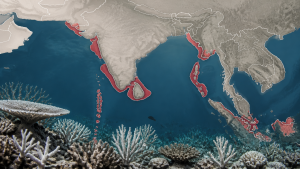
A study co-authored by scientists from the Zoological Survey of India (ZSI) classified all 13 South Asian coral reef ecoregions as “critically endangered”. Titled “Red List of Ecosystems Assessment of South Asian Coral Reefs”, it was published on October 22, 2026, under the IUCN Red List of Ecosystems. The assessment considers projected ocean warming and marine heat stress over the next 50 years.
Reef regions covered by the assessment
The 13 ecoregions cover approximately 8,282.6 sq km across India, Bangladesh, Sri Lanka, the Maldives and the Chagos Archipelago—about 4% of the world’s coral reef area. India has four: the Andaman and Nicobar Islands, Lakshadweep Islands, the south coast (Gulf of Mannar and Palk Bay), and the west coast (Gulf of Kutch). ZSI co-authors were Dr. C Raghunathan, Dr. Tamal Mondal, Dr. J S Yogesh Kumar and Dr. Chandran Rethinaraj. India contributed the largest national input to the analysis of monitoring sites.
Projected heat stress raises threat classification
Using data from the past 50 years alone, the reefs were classified as seven Vulnerable, four Endangered and two Critically Endangered. Including projected marine heat stress elevated all 13 ecoregions to Critically Endangered. Globally, 96% of assessed coral reef units, representing 99.8% of the total assessed reef area, received the same classification under future ocean-warming scenarios. The assessment was unveiled at the United Nations Biodiversity Conference (COP17) in Yerevan, Armenia.
Important Facts for Exams
- Ecosystem-level assessment: The IUCN Red List of Ecosystems assesses biodiversity above the species level, focusing on the risk of ecosystem collapse.
- Risk criteria: Its five criteria cover spatial decline and restriction, functional degradation and disruption, and quantitative collapse-risk estimates from ecosystem models.
- Critically Endangered threshold: Under criterion E, Critically Endangered formally represents a 50% probability of ecosystem collapse within 50 years.
- Collapse and extinction: Ecosystem collapse is theoretically reversible, unlike species extinction, which provides an important distinction between the two outcomes.
| Related | |
|---|---|