Supreme Court Issues Notice on Judicial Appointments PIL
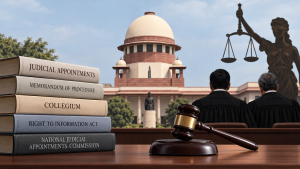
On 18 November 2026, the Supreme Court of India issued notice to the Union Government and the Chief Justice of India (CJI) on a Public Interest Litigation (PIL) filed by the NGO Lok Prahari. Justices M.M. Sundresh and P.B. Varale were on the bench.
Petition seeks revised appointments procedure
Lok Prahari has sought directions to finalise the revised Memorandum of Procedure (MoP) for appointing judges to the Supreme Court and High Courts. The plea says its revision has remained pending since December 2015, following the Supreme Court’s decision striking down the National Judicial Appointments Commission (NJAC).
The petition also seeks to bring decisions and minutes of Collegium meetings within the ambit of the Right to Information Act, with the stated aim of greater transparency.
Recusal in the case
Justice M.M. Sundresh, who is a member of the Supreme Court Collegium, initially questioned whether he should hear the matter. Justice P.S. Narasimha had recused himself on 2 November 2026, having appeared earlier in a connected matter.
Important Facts for Exams
- NJAC composition: The NJAC comprised the CJI, two senior Supreme Court judges, the Union Law Minister and two eminent persons chosen by a committee including the Prime Minister and opposition leader.
- Supreme Court collegium composition: For Supreme Court appointments, the collegium consists of the CJI and the four senior-most Supreme Court judges, unlike the smaller collegium for High Court recommendations.
- CJI office under RTI: In 2019, the Supreme Court held that the CJI’s office is a public authority under the RTI Act, subject to safeguards for privacy and confidentiality.
- High Court recommendation process: A High Court Chief Justice initiates judicial appointment recommendations in consultation with the court’s two senior-most judges; the state government may convey its views.
| Related | |
|---|---|