Scientists Discover Unusual Ozone Layer Above North Bay of Bengal
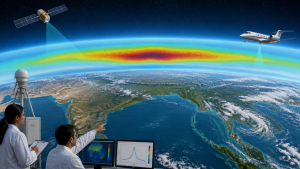
Scientists detected an unusually thick and highly concentrated ozone layer over the North Bay of Bengal at an altitude of 21 to 23 kilometres. The finding was documented on 10 August 2026 during the Phase-I NetRAD-ASMA campaign and was published in the American Geophysical Union journal Earth and Space Science.
Ozone Layer and Stratosphere
The ozone layer is a region of the stratosphere with a high concentration of ozone, a triatomic form of oxygen represented as O3. The ozone layer usually has peak concentration at about 25 to 30 kilometres above the Earth’s surface, while the detected layer over the Bay of Bengal was lower than this typical range.
NetRAD-ASMA Campaign
Phase-I NetRAD-ASMA was a nationwide scientific programme designed to study atmospheric processes and transport dynamics in India. The campaign used data from satellites, weather balloons, and atmospheric radars to examine ozone distribution and related stratospheric conditions.
Research Method and Findings
The study used an indigenously developed 206.5 MHz Stratosphere-Troposphere Radar at ARIES, Nainital, along with similar radars at Haringhata, Gadanki, and Kochi. Researchers recorded an anomalous ozone layer that persisted for more than 24 hours and found that the enhancement resulted from downward transport and redistribution of ozone-rich air.
Important Facts for Exams
- The ozone layer is located mainly in the stratosphere, which lies above the troposphere.
- Ozone is a molecule made of three oxygen atoms and is written as O3.
- ARIES stands for Aryabhatta Research Institute of Observational Sciences.
- The American Geophysical Union publishes journals in Earth and space sciences.
Key Institutions and Scientists
Dr. Manish Naja and Dr. Samaresh Bhattacharjee were identified as the key researchers from ARIES, which functions as an autonomous institute under the Department of Science and Technology. The study provided the first quantitative experimental evidence of stratospheric ozone redistribution over the Indian subtropical region during winter.
| Related | |
|---|---|